
Who's behind the news?
Who's behind the news?
How Gonzo journalism exposed the myth of objectivity—and why its lesson still matters
In our ongoing series on New Journalism we explore one of its most famous characters, Hunter S. Thompson. Much has been made of the man, his myth and, of course, his writing, but we’re here neither to praise nor bury him, but look at his ongoing influence on journalism.
Hunter S. Thompson didn’t destroy objectivity in journalism. He exposed the fiction that it had ever existed.
When NBC’s Brian Williams announced Thompson’s death in February 2005, he struggled to categorize him: journalist, author, patriot, anarchist, self-mythologizing force of nature. Thompson, Williams said, insisted his work “was never about him.” But, of course, it was—at least partly. Thompson’s lasting impact lies in how he made the reporter’s presence in the writing unavoidable, then used that presence to interrogate power, politics, and the media itself.
That move—placing the journalist visibly inside the story, sometimes even at its center—changed the rules. Not because it made journalism more personal, but because it made it more honest.
By the early 1960s, American journalism was restless. In 1963, Tom Wolfe, one of the godfathers of New Journalism, had come to detest the dull, formulaic voice of mainstream reporting. Straight news felt inadequate for a society convulsed by civil rights struggles, war, and cultural upheaval. Wolfe gave the emerging alternative a name—New Journalism—and defined it as reporting that used the tools of the novelist: scene, dialogue, character, emotional texture. Later, he added, “anything that works” to keep the reader on the page—and he meant it.
But even New Journalism often maintained the illusion of neutrality. Thompson rejected that compromise. He believed “objective” journalism was not only impossible but deceptive—an unspoken performance of authority that hid the writer’s biases and the institution’s incentives. He wrote:
“So much for objective journalism. Don’t bother to look for it here—not under any byline of mine, or anyone else I can think of. With the possible exception of things like box scores, race results, and stock market tabulations, there is no such thing as objective journalism.”
Rather than hover above events, Thompson dove in and documented the experience of being there. His reporting didn’t ask readers to trust him because he was neutral, but because he articulated everything he saw, heard, sensed, and felt.
Thompson’s 1967 book Hell’s Angels: A Strange and Terrible Saga signaled a turning point. After living and riding with the notorious motorcycle club for nearly two years, he produced an account that even Sonny Barger, the group’s de facto president, said was far removed from the caricatures found in police reports and pulp fiction. The book became a bestseller, though Thompson disliked the original cover so much he shot a photograph for the replacement himself.
The book’s success proved that first-person immersion could generate truth rather than distort it. Thompson wasn’t reporting from outside the story; he was inside its social logic. That approach challenged journalism’s exalted hierarchy of distance and detachment, suggesting that proximity—when handled rigorously—could reveal more than any pretense of neutrality.
It also helped position journalism, not the novel, as the dominant literary form of the era. As Wolfe later observed, New Journalism was competing with—and often displacing—fiction as the main event in American writing. The early 1960s were still haunted by the ghosts of Fitzgerald, Hemingway, Mailer, and Steinbeck, all of whom Thompson studied closely.
The moment that crystallized Thompson’s influence came in 1970, when Scanlan’s Monthly sent him to cover the Kentucky Derby in his hometown of Louisville. Paired for the first time with Welsh illustrator Ralph Steadman, Thompson failed spectacularly at conventional reporting. In “The Kentucky Derby Is Decadent and Depraved,” neither Thompson nor Steadman saw the race or even knew who won until the end.
Steadman, who had forgotten his colored pencils, borrowed lipstick and eyeliner from a woman he met at the track—an heiress to the Revlon cosmetics fortune—to finish his frantic, unforgettable drawings. Thompson drank heavily, his notes were chaotic, and at some point he decided the real story wasn’t the horses—it was the crowd. What he captured instead was a tableau of class ritual, drunkenness, decadence, and barely contained violence.
“The Kentucky Derby Is Decadent and Depraved” read, as one critic wrote, “like a nervous breakdown rendered in prose.” Bill Cardoso, a friend and editor at The Boston Globe, received Thompson’s notes and declared: “It’s pure Gonzo!” That was the first appearance of the term.
Thompson later explained his embrace of it: “I knew what I was doing wasn’t regular journalism—and I had to call it something.”
Gonzo wasn’t about shock for shock’s sake. It was a methodological decision: treat perception itself as evidence. Disorder wasn’t the point—the total exposure of the subject from every possible angle was.
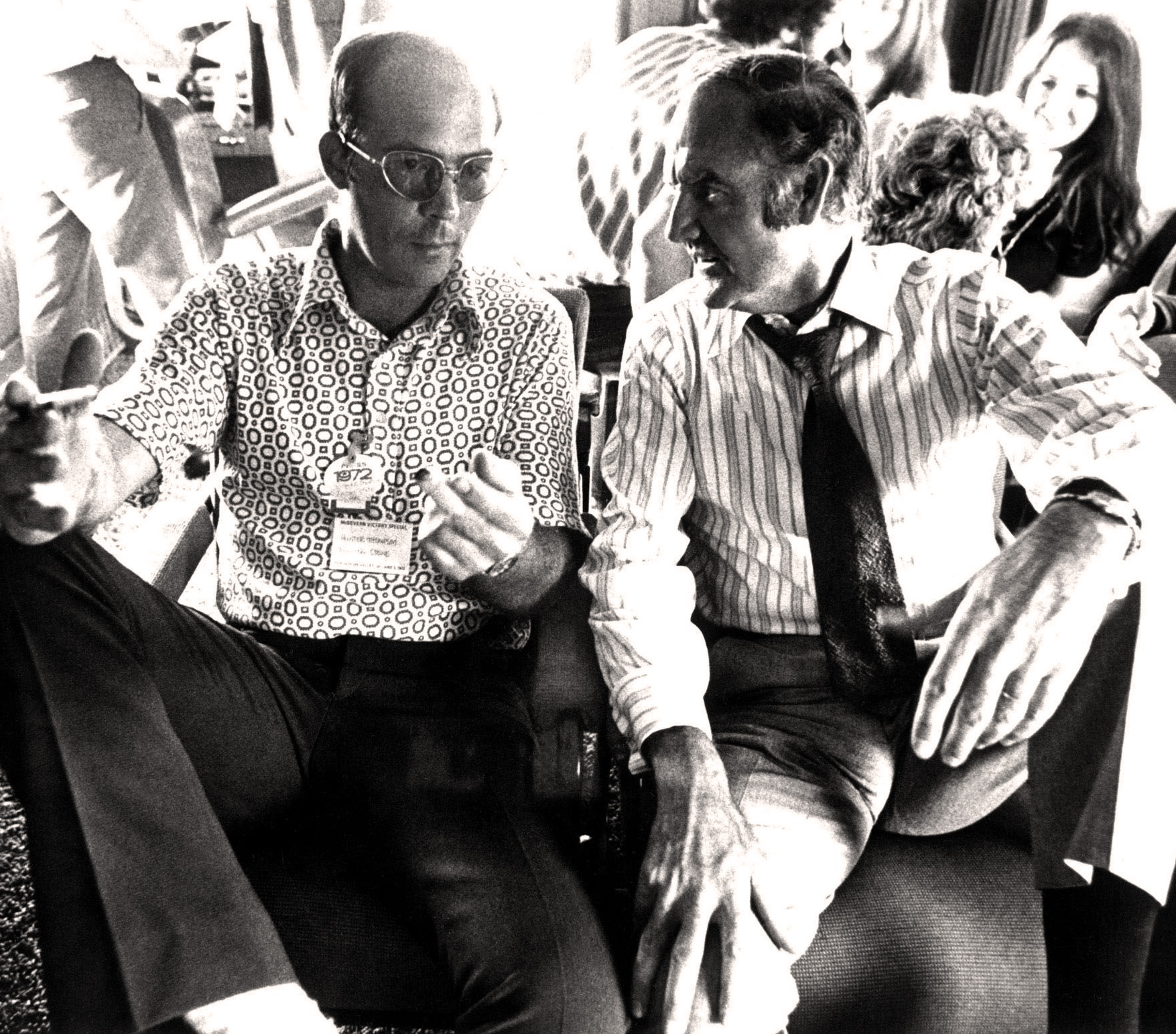
Thompson’s greatest impact came through political reporting, especially as Rolling Stone’s National Affairs Correspondent. Fear and Loathing on the Campaign Trail ’72, his chronicle of the Democratic primaries, remains a template for political writing that refuses to separate politics from media performance.
Journalist Matt Taibbi later called it “the gold standard in political journalism,” not because it was balanced, but because it was diagnostically precise. His own book Insane Clown President consciously echoed Thompson’s method.
With his scathing disdain for Sen. Edmund Muskie, Thompson spread a notorious rumor—half in jest—that Muskie was addicted to the hallucinogen Ibogaine. He later quipped, “I never said Muskie was an Ibogaine addict. I only said I’d heard a rumor that he was.”
Thompson saw campaigns not as ideological contests but as psychological performances engineered to manipulate fear, desire, and attention. The press, in his view, wasn’t a neutral observer—it was part of the terrain. That idea feels obvious now, but in the 1960s and ’70s, it was revolutionary.
During the 1970s and 1980s, Thompson’s hottest commodity became himself. The image of a dangerous, unpredictable outlaw writer was intoxicating—and confining. He resented Doonesbury cartoonist Garry Trudeau for caricaturing him as “Raoul Duke,” though that cartoon helped define his public identity.
The 1980 film Where the Buffalo Roam, starring Bill Murray, expanded his fame, and by then he was a pop-culture icon. As journalist Douglas Brinkley later noted, “Ultimately, he couldn’t satisfy his appetite for life.”
Thompson’s second wife, Anita, called him “a supreme Southern gentleman” in private, but he remained trapped by his self-created persona. As Kurt Vonnegut once wrote in Mother Night: “We are what we pretend to be, so we must be careful what we pretend to be.” Tom Wolfe added that Thompson’s compulsion “to be Hunter Thompson in every situation backed him into a corner.”
Ralph Steadman’s chaotic ink work amplified Thompson’s effect. His grotesque visuals didn’t soften the reporting—they sharpened it. Both men shared a deep contempt for greed and hypocrisy. Together, they collapsed the wall between reporting and interpretation: mood became evidence; satire became analysis; exaggeration became a vehicle for emotional truth.
This wasn’t journalism abandoning standards—it was journalism admitting that standards without courage and context were hollow.
The Kentucky Derby piece made Thompson a sensation, and his success inspired a new breed of journalists. William F. Buckley remarked that Tom Wolfe had opened the door gently, while Thompson “kicked it all the way open.”
Thompson’s political prose could be scathing. Of Richard Nixon, he wrote: “A foul caricature of himself, a man with no soul, no inner convictions, with the integrity of a hyena and the style of a poison toad.” Even Buckley, reading that line aloud in a documentary, admitted, “That’s as mean as you can get.”
George McGovern later said: “There is no question that Hunter shook up the establishment, including the establishment of journalism.”
Thompson often wrote about the decline of the American Dream—a project he never fully completed. In his Fear and Loathing in America letters (1968–1976), he wrote of struggling to find the philosophical foundation for such a book.
Other New Journalists—Didion, Capote, Wolfe—wrestled with similar themes. Thompson’s treatment was more radical: he used the Nixon years to illustrate a dream corroded by greed and corruption. He also helped shift Rolling Stone from a music magazine into a platform for political vision.
In Aspen, his home near “Owl Farm,” he watched developers transform the mountain town into a playground for the rich. It epitomized, for him, the American Dream gone bad. “The rich,” he wrote, “define themselves by what they have, not by what they do.”
He believed the typewriter was a weapon against that decay. “America could have been a monument to the best instincts of the human race,” he wrote. “Instead, we just moved in here and destroyed the place like killer snails.”
Thompson’s influence carried a warning. As fame grew, the Gonzo persona threatened to eclipse the disciplined reporter behind it. He wasn’t always sure whether audiences wanted Hunter S. Thompson or Raoul Duke. That tension prefigures today’s creator economy, where identity becomes brand and brand becomes product.
At his best, Thompson replaced convention with rigor, not chaos. His reports were outrageous because reality was outrageous, not because he was trying to be.
Today’s media environment—algorithmic outrage, cable theatrics, influencer punditry—is the attention economy Thompson diagnosed, amplified beyond anything he could have imagined. Sensation is rewarded; trust is fragile; performance often substitutes for journalism.
Thompson’s contribution wasn’t that he made journalism louder—it’s that he made its assumptions visible. He showed that the reporter is never outside the story, that objectivity without transparency is theater, and that honesty sometimes means admitting how the world feels as it burns.
Hunter S. Thompson didn’t give journalism permission to abandon the truth. He demanded it stop pretending the truth arrives without fingerprints. That demand—uncomfortable, unruly, and necessary—remains his most important legacy.
During the Clinton impeachment saga in late 1998 and early 1999, Thompson was still writing for Rolling Stone. Amid the scandal’s sordid details, he noted one unexpected fact: President Clinton’s approval ratings barely moved. After recounting the episode with typical venom and humor, he ended his column with a final, self-aware flourish:
“Trust me. I understand these things.”
Outlaw Journalist: The Life and Times of Hunter S. Thompson,
The Gang That Wouldn’t Write Straight: Wolfe, Thompson, Didion,
and the New Journalism Revolution, by Marc Weingarten
Hunter Thompson: An Insider’s View of Deranged, Depraved,
Drugged Out Brilliance, by Jay Cowan
Fear and Loathing: The Strange and Terrible Saga
of Hunter S. Thompson, by Paul Perry
© Newsjunkie 2026