
Who's behind the news?
Who's behind the news?
Part I: Birth of a nation's library
In this, our first in a four-part series on the Library of Congress, we explore the origins of the fabled collection. The library has been around almost since the founding of the United States, and it continues to be a valuable resource for government, journalists and average citizens alike. It’s the people’s library and this is how the story began.
Open a book and you’ll usually flip past the Library of Congress control number on the copyright page without paying much attention. You’ve probably imagined the Library of Congress as some kind of government registry, or perhaps just a bigger version of your local library. But it’s much more than that.
Let’s right that wrong, starting with the beginnings of The Library of Congress. Before the United States capitol settled in Washington, DC, the seat of government was in New York City, then in Philadelphia. Both of these established cities had easy access to public libraries. Washington, DC, however, did not have a significant public library until Congress created its own.
Congress passed a bill providing $5,000 for the acquisition of books for use by Congress, which President John Adams signed into law in 1800. The Library of Congress began as a reference library of approximately 964 volumes (plus a few maps), housed in a wing of the congressional building. At the time, it was only for use by Congress.
Congress then created an oversight committee for the library, which was its first joint committee.* President Thomas Jefferson approved legislation that made the LIbrarian of Congress a presidential appointee. He appointed the first two librarians, John Beckley (1802-1897) and Patrick Magruder (1807-1815).
In 1814, During the War of 1812 (which continued through 1815), British soldiers entered Maryland, mostly unopposed. In apparent retaliation for Americans setting fire to two Canadian towns and Canada’s first library, British troops set fire to the area of Washington where the library was located. Several clerks and assistants managed to escape with important documents, such as the Declaration of Independence. A downpour of rain prevented the fires from completely consuming the Capitol.
The congressional building, including the Library of Congress, was heavily damaged along with the White House and the rest of the Capitol. One volume that survived the fire, a government account book for receipts and expenditures from 1810, was taken as a souvenir by British Admiral George Cockburn. Many years later, a benefactor donated the stolen volume back to the library.
As soon as citizens who had fled the Capitol returned, one of the first things they did was start rebuilding the library. Former President Jefferson had sold his more than 6,000-volume personal library to Congress. It was Jefferson's library system that influenced cataloging the collections.
After the Civil War, Librarian of Congress Ainsworth Rand Spofford (1864-1897) convinced Congress that what they had was a national institution—a library not just for Congressional access, but for the nation. Under Spofford, the 1870 copyright law dramatically expanded the collection via deposit of published works. The US Office of Copyright is housed in the Library of Congress.
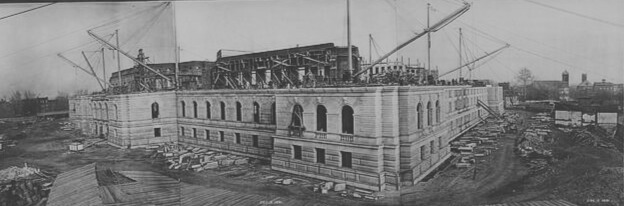
Spofford convinced Congress of the need for a separate, fireproof building to house the library. Yet the design and placement of the building could not be agreed upon. Twenty-four years passed before the Italian Renaissance-styled building would be completed and opened to the public in 1897. In 1980, it was named for Thomas Jefferson.
Under Spofford, the Library expanded its scientific literature and Americana when it acquired a large collection of books from the Smithsonian Institute as well as the book collection of politician, newspaper editor, printer, archivist, and early historian Peter Force.
The next librarian, John Russell Young (1897-1899), used his connections as a former diplomat to expand the library’s international materials. In 1897, he established the first service for the blind by creating a dedicated reading room with embossed books, laying the groundwork for the current National Library Service for the Blind and Print Disabled.
Herbert Putnam was the eighth and longest serving Librarian of Congress, from 1899-1939. He created an interlibrary loan service and made the library more accessible to scholars by publishing primary sources available through the Library of Congress. He also set up the library to receive donations and endowments.
Wealthy donors, such as John D. Rockefeller, gave money to the library. Others, such as Gertrude Clarke Whittall donated five Stradivarius violins, money from Elizabeth Sprague Coolidge created a concert hall within the Library of Congress, along with a financial honorarium created for the music division’s live concerts. Donations to the library helped create “chairs” such as the Poet Laureate Consultant.
President Franklin D. Roosevelt appointed the poet and playwright Archibald MacLeish as Librarian of Congress in 1939. During World War II, MacLeish established what became known as the Democracy Alcove, a symbolic and educational space dedicated to America’s foundational documents, including the Declaration of Independence, the Constitution of the United States, and the Federalist Papers. As wartime security concerns grew, he ordered these documents temporarily removed from public display and transferred to Fort Knox for safekeeping, where they remained until the threat had passed.
The Library of Congress campus is made up of the Thomas Jefferson building (the oldest of the three), the John Adams building (opened in 1939), and the James Madison building (opened in 1976), which was made to accommodate the expanding library collections. In 2007, a fourth building, the Packard Campus for Audio-Visual Conservation, in Culpeper, Virginia, was opened. It conserves and protects the Library of Congress’ motion picture, recording, and video archives in an environment designed with various preservation strategies.
After many librarians and changes, buildings added in the late 1930s and the 1970s, the library continued to grow and expand. It began to use computer systems to catalog the collections in the mid-1960s. By the 1990s, with the growth of the internet, it moved much of the collections to a website for digital access. The Library of Congress now has more than 15 million digital items available for viewing online, which is only 10 percent of the library’s holdings.
The Library of Congress also has a wide variety of podcasts: Folklife Today, Our Constitution, America Works, Space on the Page (Science & Science Fiction), From the Catbird Seat (a poetry podcast), La Biblioteca, African American Passages, National Book Festival, Q&A with LCM (Library of Congress Magazine), Aland Lomax and the Soundscapes of the Upper Midwest, The Exquisite Corpse Adventure, Digital Preservation, Voices From the Days of Slavery, and Music and the Brain.
There are many notable Library of Congress collections that are not fully available online, often because they include unique physical materials, complex rights restrictions, or items whose research value depends on in-person examination. The Stephen Sondheim Collection is a prime example.
While researching the music of George and Ira Gershwin at the Library of Congress, Broadway composer Stephen Sondheim was deeply impressed by both the scope of the collections and the care with which they were preserved. In 1997, he donated the first portion of his own papers to the Library. The collection—expanded and completed following Sondheim’s death in 2021—includes manuscripts, annotated scores, drafts, notebooks, and other materials that are not fully digitized and must be consulted on site.
After donating the initial portion of his papers, Sondheim sat for an in-depth, recorded interview with Senior Music Specialist Mark Horowitz, examining selected items from the collection and discussing his creative process. All eleven parts of that conversation are available on the Library of Congress YouTube channel, offering valuable context and insight. However, the interview serves as a supplement to—not a substitute for—the physical collection itself, underscoring why many of the Library’s most significant holdings remain only partially accessible online.
Along with Sondheim’s papers (and 3,000 recordings), which the Library acquired in 2025, there are the papers of composer Milton Babbitt (one of Sondheim's teachers), papers of Sondheim collaborators such as playwright Arthur Laurents, director Harold Prince, composers, Leonard Bernstein, Richard Rodgers, and Mary Rodgers.
That’s just a sample of the scale, depth, and variety to be found at the Library of Congress, which continues to grow and adapt to new forms of information. As of this writing, there are over 178 million items housed in its collections. Stay tuned for upcoming articles in this series on the Library of Congress, which will explain how to access and use this incomparable research tool.
*A joint committee is a legislative group composed of members from both the Senate and the House, that handles matters of shared interest.
© Newsjunkie 2025