
Who's behind the news?
Who's behind the news?
Part I: From private collections to a national research institution
Newsjunkie is highlighting the great research libraries of the world. We recently concluded a four–part series on the Library of Congress. With this article, we set our sights on the colonial power that once ruled our nation.
The British Library, one of the world’s great research libraries, traces its origins to the private collections of several remarkable individuals whose libraries were ultimately bequeathed to the British nation. The foundation was laid with the vast personal collection of Sir Hans Sloane, which Parliament used in 1753 to establish the British Museum. From that institution eventually emerged the Natural History Museum and, in 1973, the British Library as a separate national library.
In addition to Sloane’s holdings, the British Library absorbed other major private collections, including the library of Robert Harley, 1st Earl of Oxford and Earl Mortimer (d. 1724), the manuscripts assembled by Sir Robert Cotton (d. 1631), and the royal libraries of Kings George II and George III. Together, these collections formed the intellectual backbone of Britain’s national library.
Sir Robert Cotton, 1st Baronet of Connington, was a Member of Parliament and one of the most important manuscript collectors of early modern England. He spent his adult life acquiring rare documents, many originating from the dissolution of Catholic monasteries, whose cultural value was often unrecognized at the time.
Cotton supported the succession of James I following the death of Queen Elizabeth I and was knighted in 1603. In 1611, he was granted a baronetcy—part of King James’s effort to raise revenue through the creation of hereditary titles.
Among the manuscripts Cotton preserved are some of the most important works in English cultural history, including the Lindisfarne Gospels, the Vespasian Psalter, and the sole surviving manuscript of Sir Gawain and the Green Knight, which also contains Pearl, believed to be written by the same anonymous author. Cotton’s library rivaled those of the royal collection, the Inns of Court, and the College of Arms.
At one point, Cotton fell out of favor with the Crown, and his library was briefly closed on suspicion that it posed a threat to the state. After his death, the collection was restored to his family. His grandson, Sir John Cotton, later donated it to the nation. The manuscripts became available to researchers at the British Museum in 1753 and, in 1973, were transferred to the British Library. Today, the Cotton collection has been digitized and is included in UNESCO’s Memory of the World register.
Sir Hans Sloane and the birth of the national collections
Sir Hans Sloane was a physician and naturalist whose passion for collecting shaped Britain’s national institutions. Trained in medicine, he established a practice in London at Bloomsbury Place, treating patients that included Queen Anne and Kings George I and II.
In 1687, Sloane traveled to Jamaica, then a British colony, where he served as physician to the colonial governor and plantation owners. With the assistance of enslaved people and plantation managers, he collected hundreds of plant and animal specimens. These efforts culminated in his two-volume work, A Voyage to the Islands Madera, Barbados, Nieves, Saint Christophers, and Jamaica (1707–1725).
After returning to England, Sloane married an heiress whose wealth derived from Jamaican sugar plantations operated by enslaved labor. Profits from these plantations enabled him to expand his collection further. Scholars and dignitaries frequently visited his home to study the materials, which grew so rapidly that he first purchased a neighboring house and later moved into a Chelsea manor once associated with Henry VIII.
When Sloane died in 1753, his will bequeathed his collection to the British nation, provided Parliament paid a modest sum to his heirs. That bequest became the cornerstone of the British Museum and, eventually, the British Library.
In the same year as the Sloane acquisition, the British government purchased the Harleian Collection, assembled by Robert Harley and his son Edward Harley, 2nd Earl of Oxford. Beginning in 1704 with the purchase of 600 manuscripts from antiquarian Sir Simonds D’Ewes, the Harleys expanded their library through auctions and agents across Europe.
Edward Harley added works by literary figures such as Jonathan Swift, Alexander Pope, and Daniel Defoe. By the time of his death in 1741, the collection included more than 50,000 books, 350,000 pamphlets, and 41,000 prints—leaving his estate financially strained. The government purchased the manuscript collection for the British Museum, where it later became part of the British Library. Access to the oldest manuscripts is now granted only by special request.
As collections expanded, the British Museum struggled to house them. Materials were dispersed across London, with storage sites in Chancery Lane, Bayswater, and Holborn, while newspapers were kept at Colindale in northwest London. In 1961, a former World War II munitions factory in Boston Spa, West Yorkshire, was converted to house science and technology materials and later became an interlibrary loan center. Today, Boston Spa holds the British Library’s Newspaper Archive, much of which is digitized and available online.
Eventually, Sloane’s original collection was divided: natural history materials went to the Natural History Museum, some items remained with the British Museum, and the books and manuscripts became core holdings of the British Library.
Recognizing that the British Museum was no longer adequate, Parliament passed legislation in 1972 formally establishing the British Library as a separate institution. Planning for a new building began in 1962, but construction at St. Pancras, near Bloomsbury, did not begin until 1982 due to funding and site disputes.
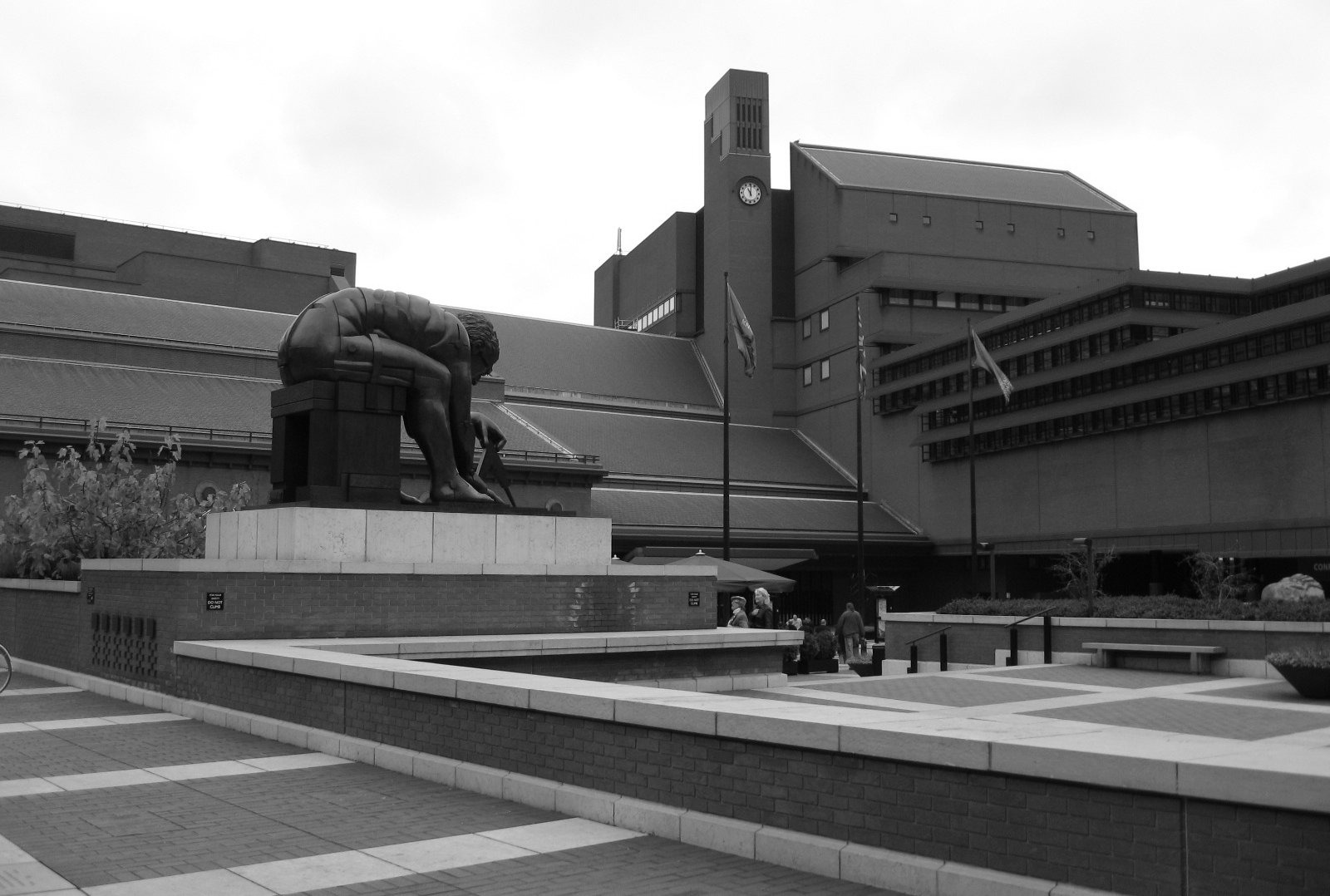
Construction was completed in 1987, but the library opened gradually as collections were transferred. Staff began operations in the mid-1990s, and the British Library officially opened to the public in 1997. The building—designed by Sir Colin St John Wilson—covers more than 1.25 million square feet, contains 14 floors, and was designated a Grade I listed building, marking it as a site of national historical importance.
The British Library today
The St Pancras site includes 11 reading rooms and is among the most heavily used research libraries in the world. Boston Spa maintains one reading room and serves as a major storage and retrieval center.
Approximately three million new research items are added to the Library’s collections each year. To accommodate continued growth, Parliament has approved plans for a major expansion of the St Pancras site into adjacent land. Many materials housed at Boston Spa can be delivered to London within 48 hours upon request.
From its origins in private collections shaped by empire, politics, and scholarship, the British Library has become a global center for research—preserving the past while adapting to the demands of the future.
Sources
British Library Building & History
https://lavenderfawn.wordpress.com/a-brief-history-of-the-british-library/
British Library Expansion
https://www.bl.uk/about/press/releases/groundbreaking-british-library-development-confirmed
Boston Spa Storage facility
British Library at Boston Spa - Buro Happold
03.BritishLibrary.SiteToday.pdf
British Library holding locations before St. Pancras
History of the British Library
British Library Newspaper Archives online
BRITISH Newspapers | NewspaperArchive
Life and collections of Sir Robert Cotton
Sloane Collection
https://sloanelab.org/sloane-collections/
Harleian Collection
The Book Collection - Harley Foundation
Memories of the World website, Sir Robert Cotton Collection
The Cotton Collection of Manuscripts | UNESCO in the UK