
Who's behind the news?
Who's behind the news?
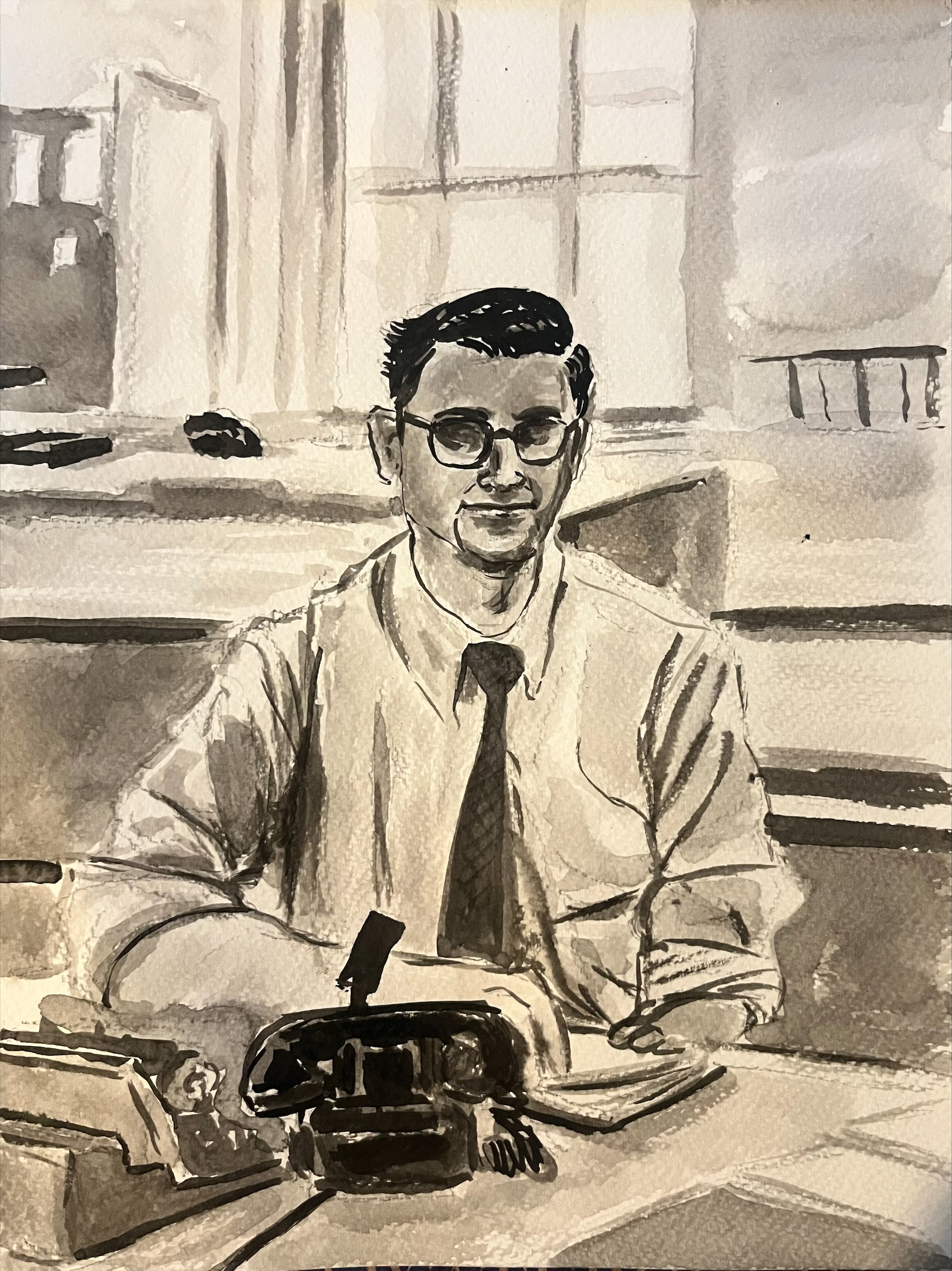
Published explosive revelations of organized crime; helped exonerate Rubin "Hurricane" Carter
Selwyn Raab, an investigative reporter for The New York Times and other news organizations, died March 14. He was 90.
Mr. Raab didn’t like the label ‘investigative reporter,’ that was often used to describe him. Rather, he said, “I believe in enterprise and patience.”
Selwyn Norman Raab was born on June 26, 1934, in Manhattan, one of two sons of immigrant parents: William Raab, a New York bus driver born in Austria, and Berdie (Glantz) Raab, a homemaker born in Poland.
Mr. Raab grew up on Manhattan’s Lower East Side, a working-class area hit hard by the Great Depression. As a child, he boxed in the 60-lb weight division for the New York City parks department. His neighbors were first- and second-generation immigrant families of Jewish, Italian, Irish, and Puerto Rican descent.
Mr. Raab’s colleague, Clyde Haberman of the New York Times, described Mr. Raab’s early years thus;
During his childhood, Mr. Raab had an early introduction to the Mafia and the criminal organization which influenced his neighborhood and the rest of the city. He told Time magazine in 1974, he was “surrounded by the kind of legendary criminals you read about—bookmakers, con artists, Jewish and Italian gangsters;" adding, “I grew up with guys I later covered." |
Mr. Raab graduated from Seward Park High School in Lower Manhattan in 1951, and later from the City College of New York in 1956, with a bachelor’s degree in English.
At City College, he was an editor of Observation Post, a student newspaper. He was suspended twice from classes and the newspaper because of the pieces he wrote. The college deemed his work “unprofessional.” The first suspension came after publishing an editorial denouncing efforts by the student government and faculty to kill the newspaper. The second followed his article criticizing college administrators who had fired several professors under attack in the McCarthy era.
He looked back on his college days in 2009 when he received the Townsend Harris Medal, an award given by City College in memory of its founder. In his remarks, Mr. Raab said his suspensions taught him a couple of things. One was “Never seek safe harbors to avoid contentious but important issues.” The other: “Never sacrifice integrity on fundamental principles, especially if there is a clear distinction between right and wrong on vital issues.” These key lessons stayed with Mr. Raab throughout his long career as a professional journalist.
Ralph Blumenthal, another former colleague at The New York Times, said that while Mr. Raab tended to be humorless, he was “a demon for the facts.” Blumenthal added, “When you think of the causes he adopted, they were groundbreaking.”
Even before Mr. Raab joined the Times in 1974, his research had already helped free men wrongly convicted of some of the New York region’s more shocking murders. One was George Whitmore Jr., who had been imprisoned for the 1963 “Career Girl Murders” of Janice Wylie and Emily Hoffert. Working first for the merged newspaper the New York World-Telegram and The Sun and then for NBC News and WNET, Mr. Raab uncovered evidence that Mr. Whitmore was elsewhere on the day of the murders. In 1967, Mr. Raab published “Justice in the Back Room,” which examined the case and exposed the police’s coercive interrogation tactics. Mr. Whitmore was exonerated in 1973, after nine years in prison.
Mr. Raab worked at the New York Times for 26 years. Reporting for the paper, he continued his criminal justice research and uncovered evidence of perjury that helped free Rubin "Hurricane" Carter, the professional boxer imprisoned for 19 years for the 1966 shooting deaths of three people in a bar in Paterson, New Jersey.
The Carter case was another instance of police coercion, as well as prosecutorial overreach. Bob Dylan's 1976 song, “Hurricane,” as well as the 1999 Denzel Washington film, “The Hurricane,” were based on the case.
As a boy, Mr. Raab was aware of the presence of organized crime in his community, an obsession that carried into his reporting. His investigative research brought the Mafia to his attention once again. At this time, many editors hesitated to undertake complex investigations into the Mafia, but Mr. Raab faced the challenge head-on.
Despite a popular tendency to look upon gangsters as “amiable rogues,” he said, they were murderous predators and “the invisible government of New York.” Mr. Raab’s reporting detailed how Cosa Nostra control extended to much of municipal life, be it garbage removal, the garment industry, unions, construction, or fish and meat markets.
Based on his extensive research and reporting, Mr. Raab wrote the 765-page book “Five Families: The Rise, Decline, and Resurgence of America’s Most Powerful Mafia Empires,” published in 2005. The book detailed the five Cosa Nostra mob families and their operations in New York. Bryan Burrough, reviewing “Five Families” for The New York Times Book Review, said that “what makes Raab so wonderful is that he eschews legend and suspect anecdotage in favor of a Joe Friday-style just-the-facts-ma’am approach.”
Mr. Raab said, “I just look for the most reasonable approach to a story."
Sources
NYT. Selwyn Raab obituary
NYT. Selwyn Raab remarks
Washington Post. Selwyn Raab obituary
NYT. John Artis obituary
NYT. George Whitmore Jr. obituary
Michael Woodiwiss. Selwyn Raab interview
Time. Kojak
© 2025 Newsjunkie.net