
Who's behind the news?
Who's behind the news?
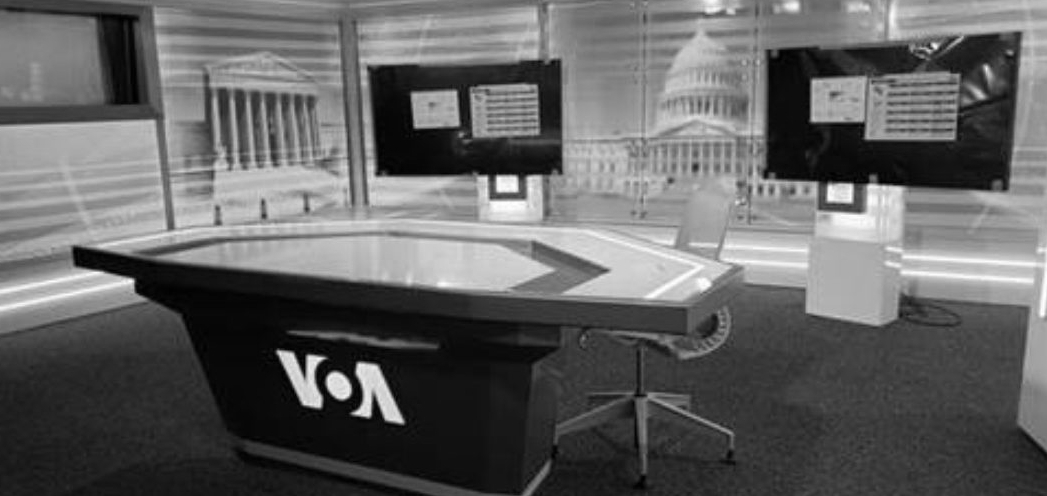
How VOA was condemned, reprieved, and what 's next
On March 17, 2026, a federal judge ordered the Voice of America (VOA) back to life. More than 1,000 employees who had spent nearly a year on paid administrative leave were told to return to work by March 23. The broadcasts—which had gone dark across dozens of languages and hundreds of countries—were to be restored. It was, on paper, a significant legal victory.
Whether it translates into an actual functioning news organization is another question entirely.
What has unfolded inside VOA over the past year is not just a bureaucratic crisis or a political struggle. It is something more revealing: a case study in how fragile public knowledge systems really are—and how swiftly they can be destroyed from the inside.
According to a former VOA staffer who spoke with us on background, the chain of events that led to VOA’s near-destruction began not with a policy memo or a long-range plan, but with a moment of presidential irritation.
Last St. Patrick’s Day (2025), during a White House photo opportunity with the Irish Taoiseach, VOA White House bureau chief Patsy Widakuswara asked President Trump a question about his proposal to remove Palestinians from Gaza. Trump asked what outlet she worked for. When she said Voice of America, he replied with something to the effect of “it figures.”
The next day, he signed an executive order directing VOA’s parent agency, the US Agency for Global Media (USAGM), to be reduced to “the minimum presence and function required by law.” An accompanying White House press release was headlined: “The Voice of America.”
Within days, more than 1,000 employees were placed on indefinite paid administrative leave. Contractors—a substantial portion of the workforce—were simply let go. Wire service contracts with the AP, Reuters, and AFP were canceled. Studios were shuttered. The agency gave up office space, including a DC building that had been set to serve as VOA’s future home.
Affiliates around the world—hundreds, possibly thousands of broadcast partners—received no advance warning.
“They pulled us offline and off the air with no notice,” the former employee told us, “without allowing us to warn our affiliates.”
What makes this story instructive is not just the political motivation but the method. VOA was not brought down by a dramatic confrontation or a high-profile editorial battle. It was brought down by administrative action: emails, revoked access, canceled contracts.
“We got emails,” the former staffer said. “We were asked to share personal email addresses in case they did something and locked us out of work emails.”
The practical effects cascaded quickly. Without wire services, there was no backbone for global reporting—no ability to verify, contextualize, or scale information. Without contractors, the institutional workforce shrank overnight. Without affiliates being warned, relationships built over decades evaporated without so much as a farewell broadcast.
The agency was placed under the control of Kari Lake, the Trump ally and former television anchor, who was installed as a senior adviser and later effectively ran USAGM as acting CEO. She moved quickly to implement the executive order to the letter.
What little programming continued—VOA was reduced from 49 language services to roughly six—was subject to new editorial expectations. Journalists who were called back to work were told, according to our source, that they were to report on “what the administration was doing and saying. No balance, no opinions.”
More alarming still, a separate lawsuit filed just this week by veteran VOA journalists alleges that Lake actively promoted pro-Trump propaganda on the air. According to the suit, VOA canceled contracts with the AP and Reuters and negotiated a deal to carry content from the right-wing One America News Network. Persian-language broadcasts reportedly featured effusive praise for President Trump and suppressed coverage of Iranian protests supporting the late Shah’s son. In one instance, a USAGM executive delivered on-camera remarks in a news-style broadcast, treating Trump’s political priorities as if they represented the interests of the Iranian public.
That kind of editorial interference is expressly prohibited by federal law, which requires VOA to serve as “a consistently reliable and authoritative source of news” and establishes a legal firewall protecting its editorial independence. But a firewall policy is only as strong as the people enforcing it.
The former staffer we spoke with spent years at VOA before eventually taking a “reluctant retirement” at the end of September 2025. When asked what is lost when experienced staff are removed. from a public knowledge institution, the answer was blunt.
“Everything. Institutional memory, best practices and news standards, ethics, unbiased reporting.”
These are not abstract ideals. They are embedded in routines: how sources are cultivated across cultures, how translation decisions carry editorial weight, how a journalist maintains credibility with an audience that has no other access to independent information. Once those routines are broken, they are not easily rebuilt.
“Is that recoverable? Yes—but it could take a decade or more,” the source said. “We have to regain the trust of audiences and affiliates.”
Trust is particularly fragile in the regions where VOA matters most. Surveys taken during a prior administration found that between a quarter and a third of Iranian households tuned in to VOA once a week. For audiences living under authoritarian information control, a disruption is not a temporary inconvenience—it is a breach of a relationship that took decades to build.
And when that breach occurs, it does not leave a vacuum. It leaves an opening.
“People like the Russians, Chinese, Iranians fill the breach with propaganda,” the former employee told us. “We started seeing that almost immediately.”
There was immediate resistance. VOA journalists, the network’s sidelined director Michael Abramowitz, and press freedom organizations fought back in court.
U.S. District Court Judge Royce C. Lamberth—a Reagan appointee, notably—has repeatedly ruled against the administration’s actions. In early March 2026, he found that Lake’s appointment as head of USAGM violated the Federal Vacancies Reform Act and the Constitution’s Appointments Clause, rendering her actions legally void. On March 17, he went further, ordering the full reinstatement of 1,042 employees and the restoration of VOA’s broadcasts, declaring that Lake and other defendants were “unlawfully withholding mandatory agency action.”
He described the administration’s approach as “a hasty, indiscriminate approach” to administrative action and found it violated the Administrative Procedure Act.
The government filed notice of appeal two days later.
A three-judge panel at the DC Circuit Court of Appeals subsequently issued a stay on the reinstatement of employees—meaning the legal battle is not over, even as the deadline for reinstatement passed Monday. The administration appears determined to fight the rulings through the appellate process, and the outcome remains genuinely uncertain.
Meanwhile, the organizational picture has grown murkier. In the wake of the court rulings, Trump nominated State Department official Sarah Rogers to serve as USAGM’s permanent CEO, pending Senate confirmation. Michael Rigas, a State Department official, was named acting CEO. Lake, who called the judge’s orders “absurd” and the lawsuits against her “malicious,” says she remains in her role as Deputy CEO. And this week came the announcement that Christopher Wallace—formerly of Fox News and most recently an executive at the conservative network Newsmax—would serve as VOA’s new deputy director.
For some observers, the Wallace appointment is cause for cautious optimism; he has spoken publicly about the importance of accurate reporting. For others, his background raises obvious questions about the administration’s intentions.
“It’s an open question whether the administration wants a real news organization or a mouthpiece,” said David Ensor, a former VOA director.
One of the more quietly remarkable aspects of this story is what has happened outside the institution itself. Former employees and sidelined journalists built the “Save VOA” website (savevoa.com) almost from the moment the shutdown began—documenting the timeline of events, tracking court rulings, and making the public case to Congress for continued funding.
It worked, partially. Congress approved roughly $200 million for VOA operations—about a 25% cut from previous appropriations, but a bipartisan signal that the legislative branch was not prepared to simply defund the agency at Lake’s request.
“The Save VOA campaign was meant to reach Congress,” the former staffer said, “to ensure that they funded us even though Kari Lake was telling them not to.”
That Congress acted against the administration’s preferred outcome is significant. It suggests there are still political limits to the dismantling. But funding is not the same as a functioning leadership, and a court-ordered return to work is not the same as independence.
Even with a court order and congressional funding, the path back for VOA is not straightforward. Physical infrastructure—studios, equipment, distribution contracts—takes time and money to restore. Widakuswara, one of the lead plaintiffs in the lawsuit, noted that “restoring the physical infrastructure is going to take a lot of money and some time, but it can be done. What is more difficult is recovering from the trauma that our newsroom has gone through.”
And then there is the question our source returned to repeatedly: whether the content that is now being produced—particularly as it passes through translation into dozens of languages—is being altered in ways that are difficult to detect.
“That’s never been allowed,” they said. “But…” The sentence trailed off. That ellipsis represents the central uncertainty hanging over VOA’s future. Courts can order reinstatement. They cannot order trust. They cannot mandate the restoration of norms that took generations to build.
“It will take ages and ages and ages,” the former employee said. “And they will need some of us old hands to figure it out and untangle the mess they made.”
VOA is not an isolated case. Across the federal government, a similar pattern has played out: agencies that appear robust until subjected to sustained political pressure discover that their apparent stability was always conditional. Their strength was embedded in routines, norms, and relationships—not in the law alone.
Remove the people who carry those norms. Cancel the contracts that support the mission. Install leadership with no stake in institutional credibility. The agency still exists. It still has a name and a legal mandate. But it no longer produces the same kind of information, knowledge, and personality.
The quietest form of subverting the Constitution: continuity without integrity.
VOA was founded in 1942, in part to counter propaganda with verified information. That the institution now finds itself fighting off allegations of being converted into a propaganda vehicle is, at minimum, a dark irony.
Whether a new administration, or a new legal landscape, can restore what was lost is an open question. Our source offered a cautious, conditional answer.
“I fear it will take a different administration,” they said. “And even then, recovery will depend on something harder to legislate: the restoration of norms.”
Peter Landau is Managing Editor of Newsjunkie.net
© 2026 Newsjunkie.net