
Who's behind the news?
Who's behind the news?
How the federal web presence is changing and who it affects
This report analyzes 641 entries from the Tracking Gov Info (TGI) project, a crowdsourced dataset covering federal web pages, tools, and documents altered or removed between April 2025 and July 2026. Most entries are websites and tools (61%) or documents, reports, and articles (19%). The two dominant event types are removal followed by reinstatement (37%) and outright removal (34%). Of 236 reinstated entries, 198 (84%) trace to Doctors for America v. Office of Personnel Management (OPM). Court orders have forced agencies to restore public-facing pages. Comparing these restorations with the underlying federal data removals shows that restored pages often still lack the specific data element targeted for removal. The result is a gap between restored public access and the data the government continues to collect about the affected populations.
Data for this analysis comes from the Tracking Gov Info (TGI) project’s “Gov. Info. Tracker,” a crowdsourced dataset of 641 reported government document removals. Public submissions are reviewed, verified, and metadata-labeled by an editorial team of academic librarians: Jenny McBurney, Molly Blake, and Kate Sheridan (University of Minnesota, Twin Cities), Sanga Sung (University of Illinois, Urbana-Champaign), and Ben Amata (California State University, Sacramento), according to the project’s About page and FAQ ("Who can add missing websites and documents to the Gov Info Tracker?").
This analysis uses the Type, Action, Department/Agency, Office, Notes, Preservation Status, and Timestamp fields.
The corpus covers 641 entries logged between April 15, 2025, and July 2, 2026. The entries contain Title and Notes fields, which were used for content analysis. For reinstated entries specifically, the timestamp often represents when the restoration was noticed, not the original removal date. For that reason, this report does not chart entries over time. That detail is available in the collected data but is not treated here as reliable evidence of when events happened.
Department and Agency values were mapped to the policy-domain taxonomy used in dataIndex.us (Nielsen Garcia, 2026), a prior report on federal dataset removals and modifications. The taxonomy groups datasets into domains such as Health, Immigration, and Climate. Applying the same taxonomy here allows direct comparison between changes to public-facing government information and changes to federal datasets and data elements.
After applying the policy domain taxonomy, 9.4% of classified rows fall outside any mapped domain ("Other / unmapped"), mostly cross-cutting or administrative agencies (OMB, GSA, NARA, Smithsonian) that do not map to one substantive policy area.
Each entry’s stated reason or topic was classified using the human-in-the-loop (HITL), LLM-based close-reading method inspired by Chang et al. (2026), but adapted to work through API calls rather than an LLM chat UX. Classification covered 635 of 641 rows with a non-null Notes field and used gpt-4o-mini via the OpenAI API with JSON-constrained output. The taxonomy has seven multi-label classes: gender identity/sexual orientation, diversity, equity, and inclusion, climate, immigration, cost and reorganization, oversight and accountability, and no stated reason. The prompt was revised once (v2) after an audit identified three recurring errors: Doctors for America v. OPM rows defaulting to no stated reason, under-classification of oversight and accountability, and failure to classify EPA content beyond explicit references to "climate change" as environmental. The full corpus was then reclassified.
Table 1. Validation performance, initial random pilot sample (n = 25).
Class | Precision | Recall | F1 | n |
Gender identity/sexual orientation | 0.92 | 1.00 | 0.96 | 12 |
Diversity, equity, and inclusion | 0.80 | 1.00 | 0.89 | 4 |
Climate | 1.00 | 1.00 | 1.00 | 2 |
Immigration | 0.00 | 0.00 | 0.00 | 0 |
Cost and reorganization | 1.00 | 0.67 | 0.80 | 3 |
Oversight and accountability | 0.83 | 1.00 | 0.91 | 5 |
No stated reason | 1.00 | 0.67 | 0.80 | 3 |
Micro average | 0.90 | 0.93 | 0.92 | 25 |
Macro average | 0.79 | 0.76 | 0.77 | 25 |
Weighted average | 0.91 | 0.93 | 0.91 | 25 |
Table 2. Validation performance, expanded sample stratified to include the immigration class (n = 35).
Class | Precision | Recall | F1 | n |
Gender identity/sexual orientation | 0.95 | 1.00 | 0.97 | 18 |
Diversity, equity, and inclusion | 1.00 | 1.00 | 1.00 | 6 |
Climate | 1.00 | 1.00 | 1.00 | 2 |
Immigration | 0.50 | 1.00 | 0.67 | 1 |
Cost and reorganization | 1.00 | 0.75 | 0.86 | 4 |
Oversight and accountability | 0.83 | 1.00 | 0.91 | 5 |
No stated reason | 1.00 | 0.67 | 0.80 | 3 |
Micro average | 0.93 | 0.95 | 0.94 | 35 |
Macro average | 0.90 | 0.92 | 0.89 | 35 |
Weighted average | 0.94 | 0.95 | 0.94 | 35 |
The tracker is dominated by web content: 61% of the 641 entries are websites, tools, or interactive resources, and 19% are documents, reports, or articles. Staff actions account for 5%, datasets/databases 4%, and the remainder consists of smaller categories such as agency/office/program pages, advisory committees, and grants. By action, 37% of entries were removed and later reinstated, 34% were removed outright, 11% modified, and 8% terminated. Removal and reinstatement together account for roughly seven in ten tracked events.
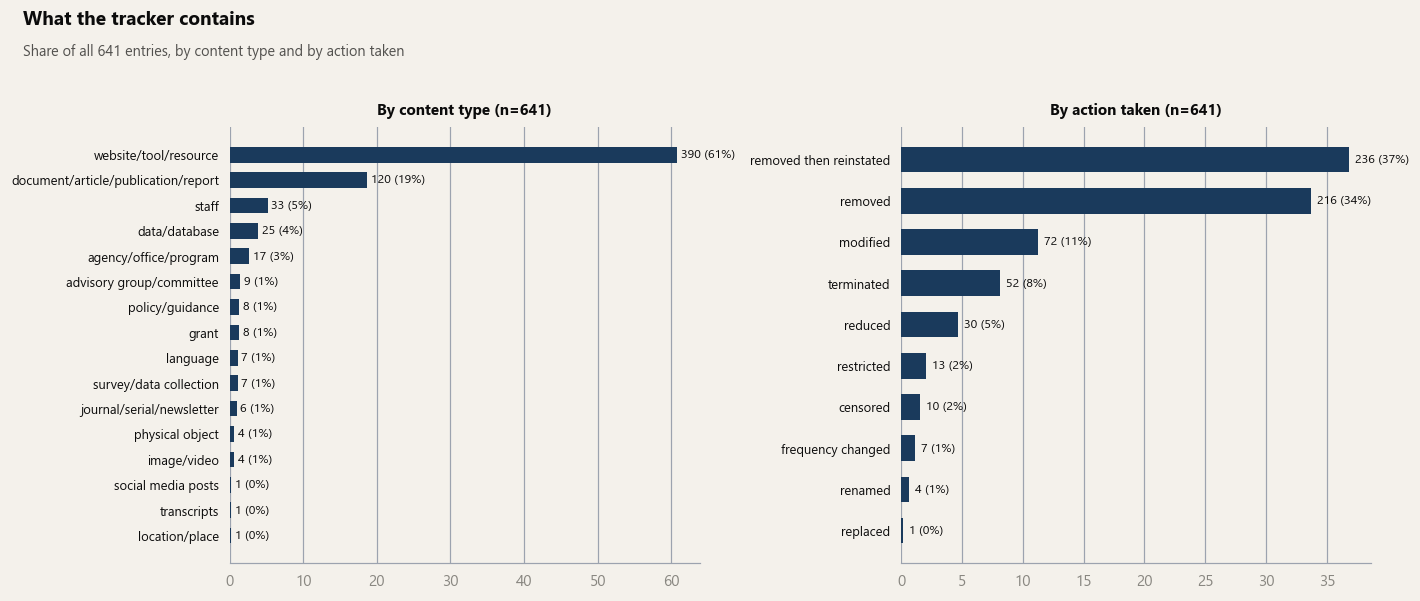
Figure 1. What the tracker contains, by content type and by action taken.
Health-related agencies (CDC, HHS) account for more tracked activity than any other domain, followed by Justice and Defense. Classifying each entry's stated reason for removal shows gender identity/sexual orientation as the largest class by a wide margin, 264 of 635 classified entries (41.6%), ahead of oversight and accountability (99), cost and reorganization (86), diversity/equity/inclusion (78), climate (53), and immigration (31). Only 96 entries (15.1%) carry no inferable topic; most removals in this tracker have an identifiable subject even where no agency states a reason.
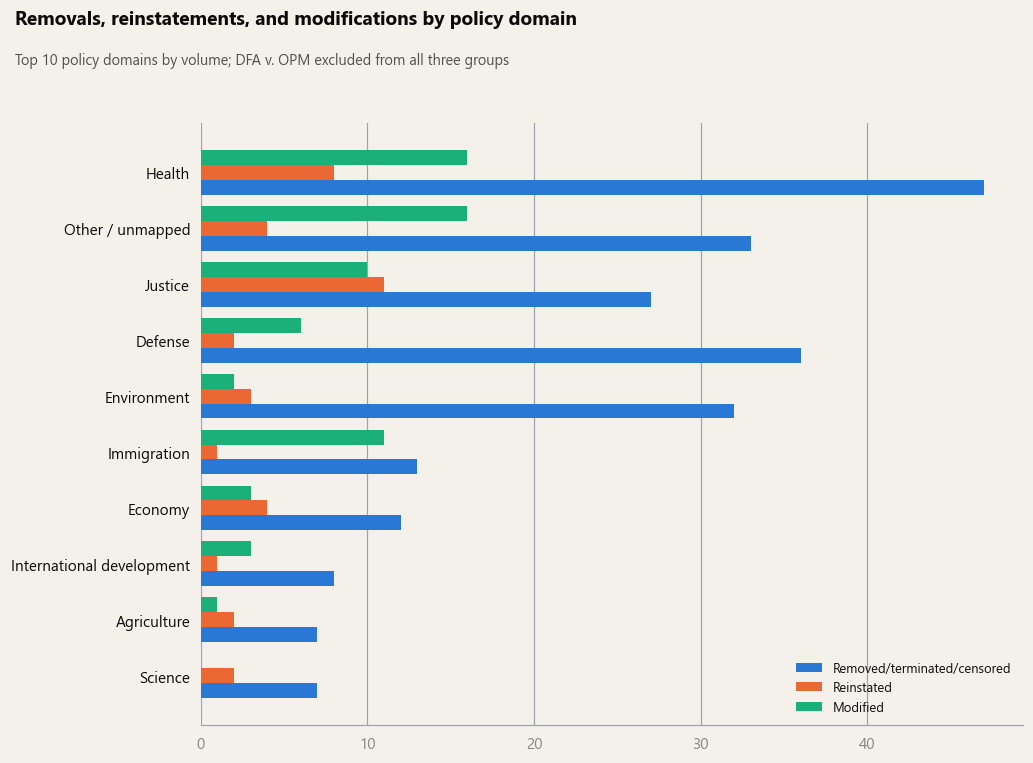
Figure 2. Removals, reinstatements, and modifications by policy domain.
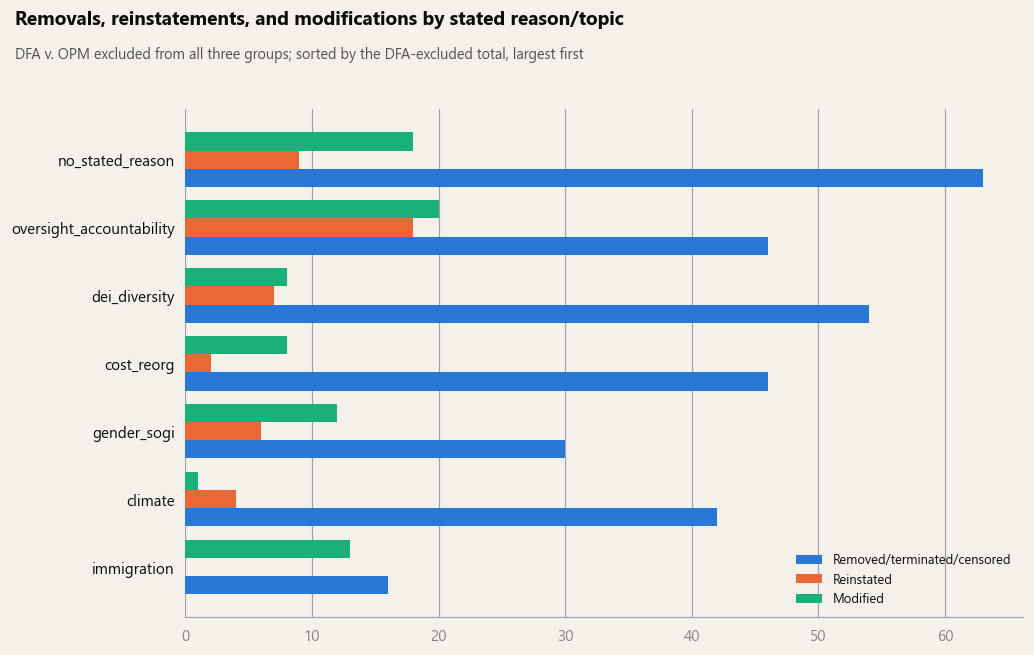
Figure 3. Removals, reinstatements, and modifications by stated reason/topic.
Marking court-ordered reinstatements separately shows their concentration. In the Health domain, nearly the entire reinstated bar is court-ordered, while reinstatements in other domains are mostly non-court-ordered. By stated reason/topic, court-ordered reinstatements are concentrated in the gender identity/sexual orientation class. Oversight and accountability and cost and reorganization also have substantial reinstatement counts, but little of that activity is court-ordered.
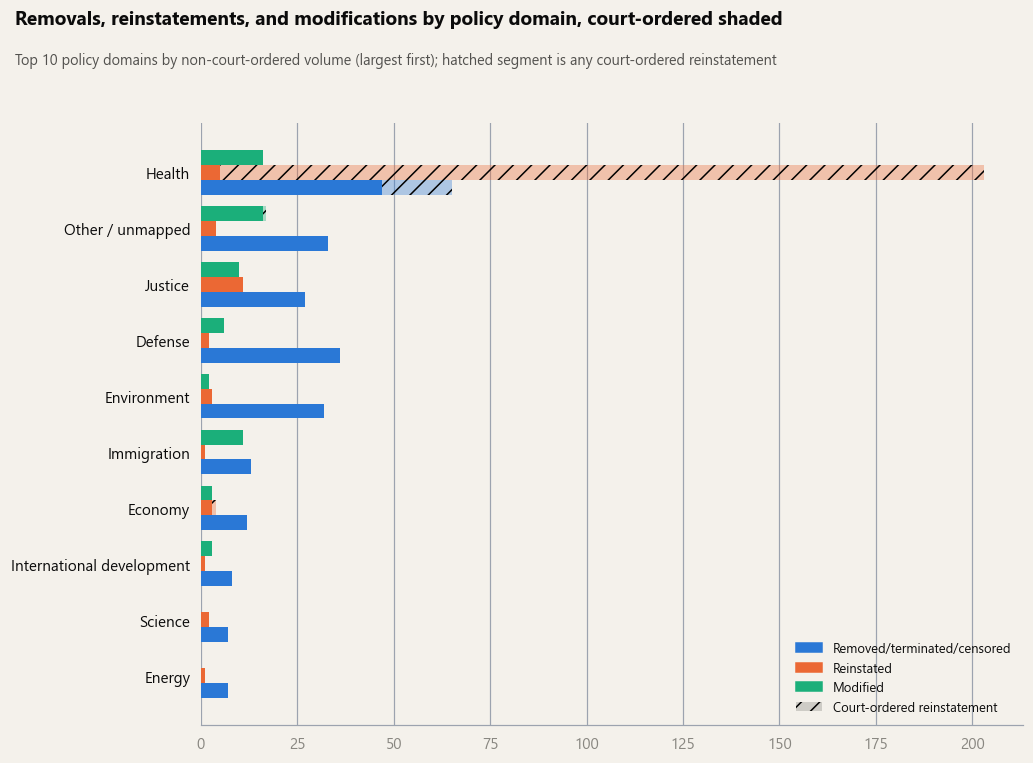
Figure 4. Removals, reinstatements, and modifications by policy domain, court-ordered shaded.
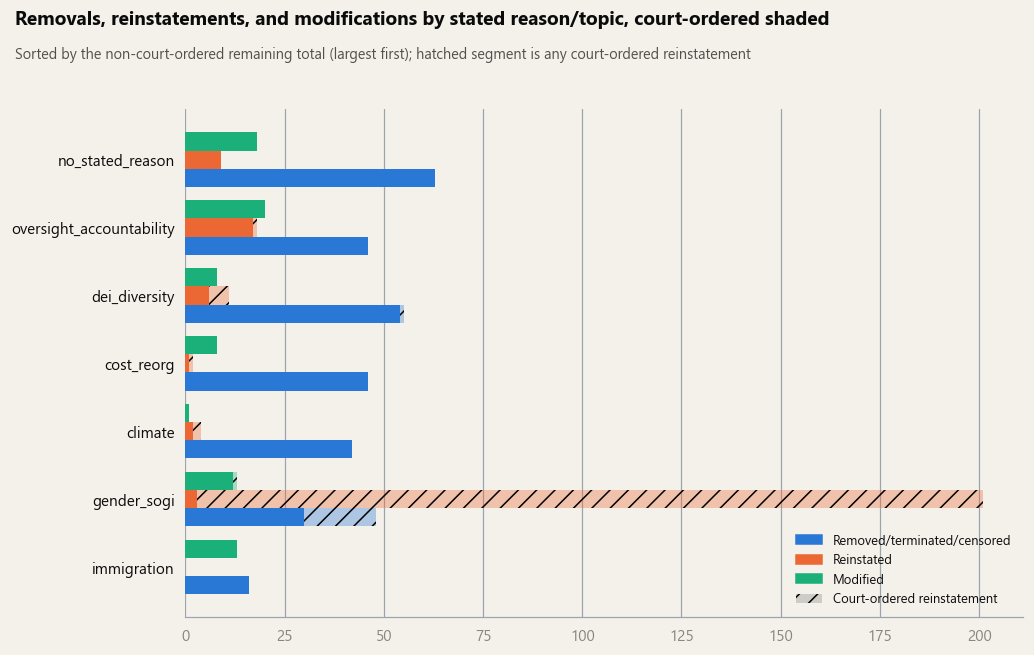
Figure 5. Removals, reinstatements, and modifications by stated reason/topic, court-ordered shaded.
Of the 236 reinstated entries, 198 (84%) are tied to Doctors for America v. OPM, 31 (13%) have no identified reason, and the remaining 7 are split among four smaller mechanisms: two additional court cases (USDA climate pages and OMB apportionments), media/public backlash without litigation, and agency correction of a data error. Across the three identified court cases, court orders account for 201 of 236 reinstatements (85.2%).
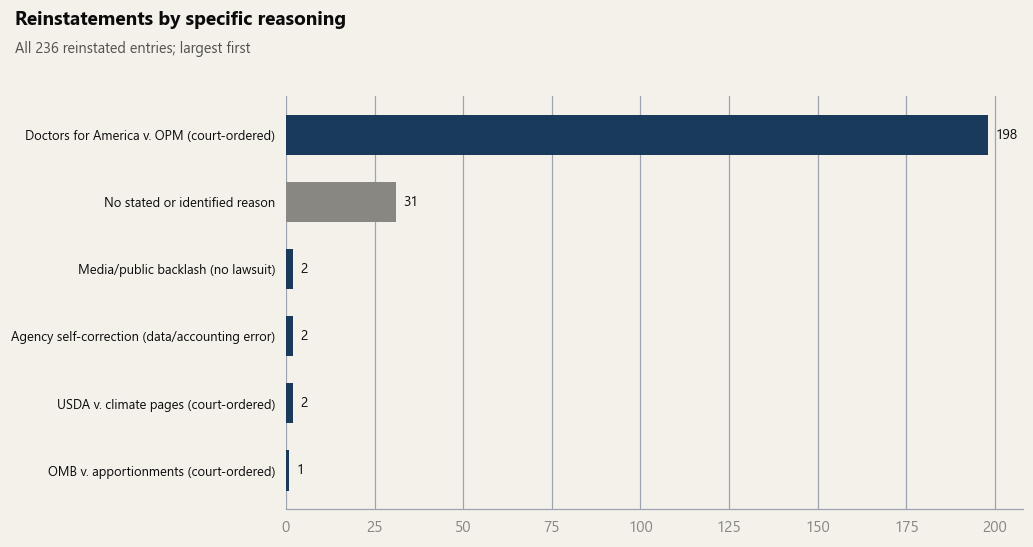
Figure 6. Reinstatements by specific reasoning.
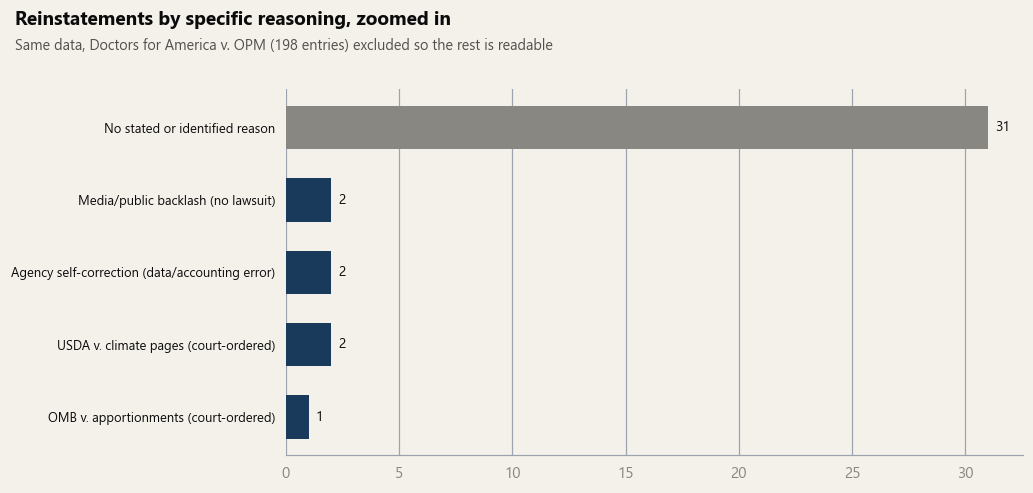
Figure 7. Same data, Doctors for America v. OPM excluded so the smaller categories are readable.
Courts have repeatedly required agencies to restore public-facing material that had been removed, restoring access for journalists, clinicians, researchers, and other users who rely on those pages. Every court order identified here addresses public-facing access. The Bates TRO covering most court-ordered reinstatements in the tracker explicitly permitted agencies to continue a "rolling review" of restored content for executive-order compliance. The order halted the mass takedown while allowing the underlying content review to continue.
dataIndex.us tracks the underlying survey instrument, while TGI tracks the public-facing page. Two datasets can be matched by name across both sources: BRFSS and YRBSS, each covered by the same February 2025 court order. TGI records both as "removed, then reinstated." dataIndex.us records both as "data elements removed," with Caveats stating that each survey continues without the gender-identity item targeted for removal. In these two cases, the webpage was restored while the survey question remained removed.
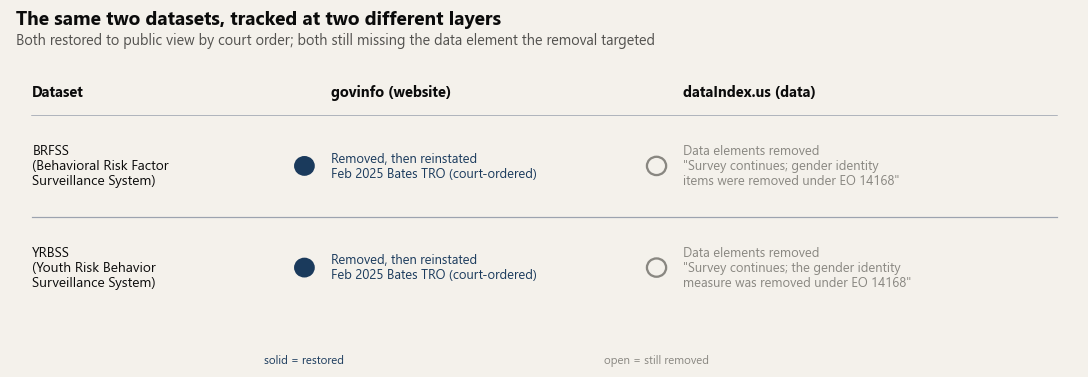
Figure 8. The same two datasets, tracked at two different layers.
Across dataIndex.us’s full set of 337 element-level removals, 94.7% of gender-identity removals (233 of 246) left the collection running without the item, compared with 86.8% of other removals (79 of 91). BRFSS and YRBSS provide two named examples within that broader pattern.
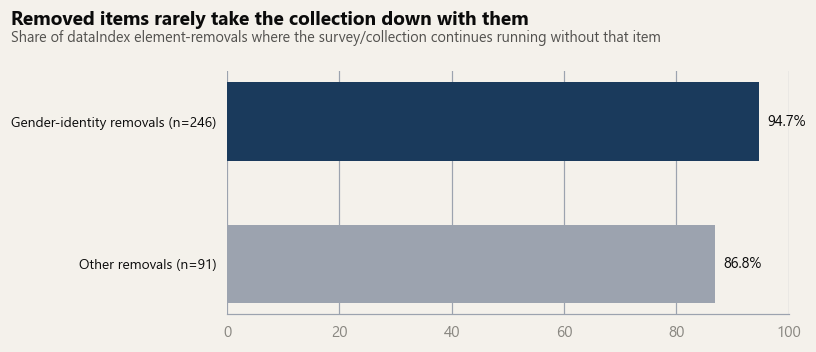
Figure 9. Removed items rarely take the collection down with them.
"Reversed" and "restored" refer to different layers that the tracker does not distinguish. A court order that restores a webpage provides verifiable recovery of public access, and litigation accounts for most identified reversals in this tracker. Every confirmed court order here addressed public-facing access. In the one cross-source comparison available here, BRFSS and YRBSS, the webpages were restored while the underlying survey instruments remained changed. A reported "restoration" therefore establishes that a page is available again, not that the removed data element has returned. The next step is to extend the name match between TGI and dataIndex.us beyond BRFSS and YRBSS and test whether this gap persists across a larger directly comparable sample. Removing self-reported gender-identity variables reduces the information available to federal and private-sector analysts about the populations those variables describe.
Chang, Tien-Chih, Alice R. P. Li, Chia-Yu Wang, and John J. H. Lin. 2026. “From Automation to Thinking: The Role of AGI in Discourse Analysis of Computer-Supported Collaborative Learning Based on Computational Grounded Theory.” Computers & Education 247 (July): 105579. https://doi.org/10.1016/j.compedu.2026.105579.
Nielsen Garcia, C. Sept 14, 2026. “True impact of data removals by policy domain: Disaggregating federal dataset terminations from data-element removals”. Newsjunkie
Qin, Amy, and Flávio Pessoa. 2026. “Trump 2.0 Has Deleted or Altered Nearly 400 US Datasets, Endangering Public Health, Education and More.” US News. The Guardian, August 18. https://www.theguardian.com/us-news/ng-interactive/2026/aug/18/trump-federal-data-deleted-altered.
Tracking Gov Info. About page. https://sites.google.com/umn.edu/trackinggovinfo/gov-info-tracker. Editorial team: Jenny McBurney, Molly Blake, and Kate Sheridan (University of Minnesota, Twin Cities), Sanga Sung (University of Illinois, Urbana-Champaign), Ben Amata (California State University, Sacramento).
NPR. (2025, February 11). Judge orders restoration of federal health websites. https://www.npr.org/sections/shots-health-news/2025/02/11/nx-s1-5293387/judge-orders-cdc-fda-hhs-websites-restored
FierceHealthcare. (2025). HHS may conduct 'rolling review' of health web pages for Trump EO compliance, judge rules. https://www.fiercehealthcare.com/regulatory/physician-group-sues-reverse-agencies-health-webpage-data-blackout
Earthjustice. (2025, May). USDA Reverses Course, Commits to Restore Purged Climate Webpages in Response to Farmers' Lawsuit. https://earthjustice.org/press/2025/usda-reverses-course-commits-to-restore-purged-climate-webpages-in-response-to-farmers-lawsuit
Federal News Network. (2025, August). OMB restores public spending database after losing court cases. https://federalnewsnetwork.com/budget/2025/08/omb-restores-public-spending-database-after-losing-court-cases/
Meyer, I. H., & Bouton, L. J. (2025, February). Impact of Executive Order on Federal SOGI Data Collection. Williams Institute, UCLA School of Law. https://williamsinstitute.law.ucla.edu/publications/sogi-data-collection-removal
dataIndex.us. Terminations Tracker. [Companion source, structural/data-element-level tracking used for the comparison in this report's final section.]
Gender identity/sexual orientation (gender_sogi), LGBTQ/transgender/gender-identity/sexual-orientation content or removals. Includes all Doctors for America v. OPM court-case rows (that litigation concerns HHS/CDC LGBTQ+ and HIV-related content specifically)
Diversity, equity, and inclusion (dei_diversity), DEI/diversity/equity content, race & ethnicity, Indigenous-specific content, and general historical/representation content about women or minority groups (e.g. women's history, Holocaust/Jim Crow/civil-rights history, women veterans) even without the word "DEI" appearing
Climate (climate). This class covers climate change and environmental content more broadly (environmental history, education, justice, science); being an EPA/DOI/NOAA entry is a hint but not sufficient alone. Agency-governance stories (advisory committees, reorganizations) belong under oversight and accountability or cost and reorganization instead unless the content itself is environmental
Immigration (immigration). This class covers immigration, asylum, or EOIR/immigration-court case-processing data
Cost and reorganization (cost_reorg), an office, program, or staff being eliminated, consolidated, or reorganized, can be implied (e.g. "eliminate," "close," "consolidate," "downsize"), not only an explicit cost-savings statement
Oversight and accountability (oversight_accountability), OIG/Inspector General reports or audits, FOIA materials, advisory committee pages, budget/performance transparency, watchdog databases, press-access restrictions, or records-management pages
No stated reason (no_stated_reason). None of the above genuinely apply, or no reason/topic is evident
Read the Prairie Fire newsletter for further analysis of this report.
Original work by Christian Nielsen Garcia, for Dharma Road, Inc. First published by Newsjunkie.net. This work is licensed under a Creative Commons Attribution-NonCommercial 4.0 International License CC BY-NC 4.0.
Permitted Use: You are free to share, copy, and redistribute this material in any medium or format, provided you give appropriate credit to the original creators and do not use the material for commercial purposes.
Permissions Beyond Scope: For academic, news journal, or commercial republication permissions beyond the scope of this license, please contact editor@newsjunkie.net.