
Who's behind the news?
Who's behind the news?
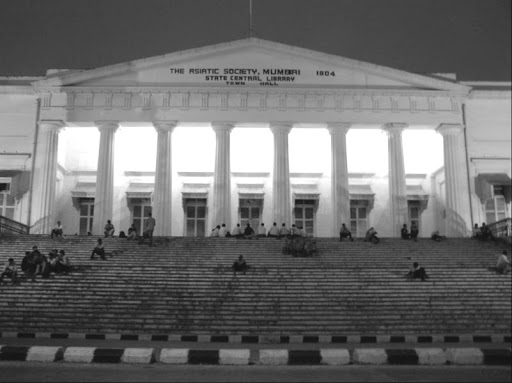
An interview with Vispi Balaporia, President of the Asiatic Society of Mumbai
On February 4, 2026, in Mumbai, Maharashtra, Newsjunkie publisher Gordon Whiting spoke with Vispi Balaporia about her work leading the historic Asiatic Society of Mumbai. They discussed the mission, collections, challenges, and future of the institution. While not directly addressed below, there is an intense, politically charged battle for control over the 221-year-old Asiatic Society, which will influence its future.
What is the mission of the Asiatic Society, and specifically the library?
We like to say that we are primarily a research library. People conducting research in areas of history—not specifically religious studies, though Buddhism may be studied from a historical perspective—come to us for reference.
We have about 150 old manuscripts that researchers frequently consult. Otherwise, we function as a general reading library, though our strengths are more specifically in history and literature.
Could you give us a sense of the breadth of the collection and some specific examples?
First, I should clarify that we are not a public library. You must apply for membership to the Asiatic Society. Applications are reviewed for suitability, and there is an entrance fee.
We have various categories of membership: life membership and annual membership. Life membership is currently 20,000 rupees [about US $220], and annual membership is 3,500 rupees [about US $38]. Annual members must remember to renew each financial year, which runs from April to March. If you fail to renew, you may have to go through the process of fresh membership again, so it is best to renew on time.
We have a website where you can explore what is available. About ten years ago, we established another portal called Granth Sanjeevani—“granth” meaning books and “sanjeevani” referring to knowledge. You do not have to be a member of the Asiatic Society to join Granth Sanjeevani, though members receive a subsidized rate. Others may join at a higher fee and access the digital materials available.
We have a collection of approximately 300,000 books, and we continue adding new publications. We also hold valuable old publications and rare manuscripts that may not be easily found elsewhere.
We have a collection of approximately 300,000 books, and we continue adding new publications. We also hold valuable old publications and rare manuscripts that may not be easily found elsewhere.
We are very proud of our 14th-century edition of Dante’s Divine Comedy. It is in old Italian, so I do not know how many current Italian speakers could easily read it, but it is a beautiful volume.
We also have palm-leaf manuscripts and wooden-strip manuscripts tied together—read one strip at a time rather than as a full page. The colors are extraordinarily well preserved. These are truly artifacts.
Would scholars or journalists need special credentials to access original materials?
Yes. You need to pay a fee. You can have one-day access from morning until evening. If you are a foreign research scholar, you can pay a higher fee for month-long access. Each category has its own payment structure.
How would you describe the audiences the library serves?
Our audience varies. Some are PhD students, and we have a student membership category with reduced fees. Others may be writing conference papers or conducting independent research.
We also have a rare book collection. Visitors may pay a small fee to enter the special collections room, where a staff member assists them. For example, we have beautifully illustrated volumes on birds and snakes. The colors are remarkably preserved. The text may not be extensive, but the illustrations are extraordinary.
The Asiatic Society was established in 1804, during the British period, by about seven individuals connected with the East India Company. They wanted an institution devoted to knowledge. Early meetings focused primarily on India and Asia. The minutes of those meetings—written in elaborate calligraphy—have been preserved. They are beautiful to look at, though not easy to read.
When you began your presidency, what was your goal?
Before serving six years as President, I was Honorary Secretary, so I was aware of the administrative needs. We have various subcommittees—for example, one for public lectures.
We also have the Mumbai Research Centre, which encourages members to contribute by writing papers, presenting talks, or organizing walking tours. Mumbai is such a large city that one cannot claim to know every part of it. The Research Centre organizes walks through certain localities, visits to places of worship—Hindu temples, mosques, synagogues—and areas where the modern city has not completely erased the historic character.
Members sometimes lead these walks to give participants a sense of what these neighborhoods once were like.
Are you attempting to document Mumbai itself through these efforts?
Yes, absolutely.
Tell us about your digitization project. How far along is it?
Granth Sanjeevani contains our digital materials, which allows access from anywhere in the world.
Is it complete?
Complete in the sense that many publications not under copyright have been digitized. We have not posted copyrighted material because there are rules regarding that.
Can foreigners become members?
Yes. They may join annually or for life.
Have you had foreign members?
Yes. Some years ago, when I was Honorary Secretary, a gentleman in the United States became a member and then placed our material on another website, offering it free. We had to intervene and threaten legal action, because that is not the purpose of membership. He claimed he was performing a public service, but not at our expense. We eventually had to write directly to the hosting site to have the material removed.
What challenges is the Society facing right now?
One major challenge is financial sustainability. We cannot generate enough income independently to ensure survival. We depend on grants.
For many years, the Ministry of Culture in Delhi has provided an annual grant of one crore rupees. In the past three years, we persuaded the Maharashtra Government to match that amount. However, their grant comes with conditions—we must submit detailed utilization accounts, and Maharashtra funds cannot be used for salaries.
We cannot generate enough income independently to ensure survival. We depend on grants. For many years, the Ministry of Culture in Delhi has provided an annual grant of one crore rupees. In the past three years, we persuaded the Maharashtra Government to match that amount. However, their grant comes with conditions…
This is difficult because we cannot fulfill our mission without staff. Delhi has not been as restrictive about salaries, but remaining silent does not make the situation easier. Paying salaries is our greatest challenge. We look for donors who can contribute without imposing such conditions.
How can the international community support the Society?
Unfortunately, to accept foreign funds, we require a federal financial registration that must be renewed annually. We once had it, but years ago it lapsed because those in charge did not realize it required annual renewal. The bank handled the accounts, but no one understood the renewal process was separate.
It has become increasingly difficult to reestablish it. Renewal would have been much simpler.
So at present, foreign financial contributions are difficult?
Yes.
What about in-kind donations, such as collections from abroad?
Possibly. But I will share an example. Some years ago, a gentleman in the United States left funds in his will—$3,000 or $5,000—to be distributed to libraries, and we were selected as one of them. However, because our federal registration had lapsed, we could not accept the funds.
More recently, a gentleman in Australia who frequently visited the Asiatic Society left 30,000 Australian dollars in his will for us. We are trying to determine whether there is a way to accept it, perhaps through an intermediary in India.
What would you like to say to our international readers—journalists, researchers, historians?
We would be very happy to involve them as members. Despite current constraints, they can approach us with specific needs, and we will try to respond.
What is a library for? It exists to keep knowledge accessible. Sadly, even our local members are not visiting as often as we would like. Mumbai has expanded, and we are located downtown. Many members now live in distant suburbs and must use multiple forms of transport to reach us. That requires effort.
Still, members may borrow up to 15 books at a time and keep them for a month. Some come for scholarly research; others come for general reading.
We would be very happy to make our resources available to your colleagues and readers, though, as I’ve explained, we face challenges regarding membership and payment. Ω
© 2026 Newsjunkie.net