
Who's behind the news?
Who's behind the news?
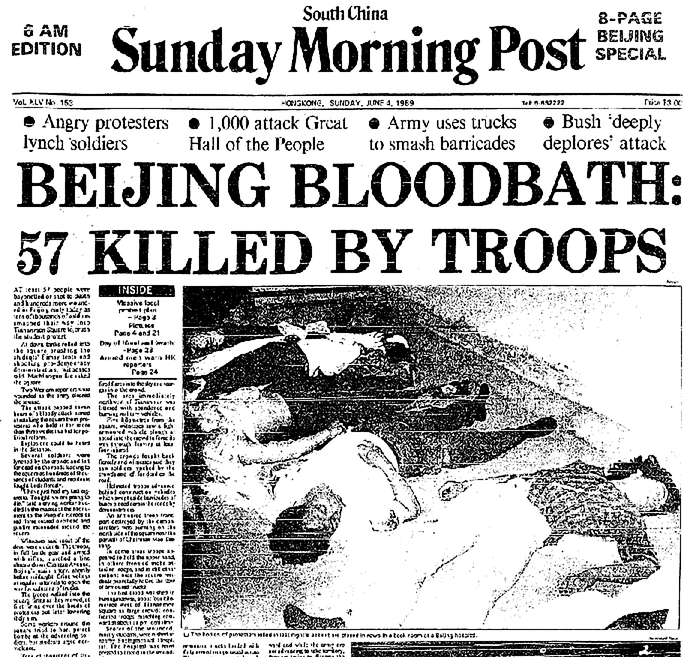
Reporting the horror of Tiananmen Square
On June 4, 1989, Hong Kong readers woke to a front page that left little room for denial. The Sunday Morning Post, in an eight-page Beijing special, carried a banner headline across page one: “BEIJING BLOODBATH: 57 KILLED BY TROOPS.” Beneath it ran a large photograph of bodies stretched on the ground, the dead displayed without euphemism or official disguise. The paper did not wait for the Chinese government’s preferred language, and it did not pretend uncertainty where there was none. It told readers that troops had killed people in Beijing. That was the story, and the headline fixed responsibility at once. The paper’s own later Tiananmen retrospective preserved the same blunt account, describing a “brutal military crackdown” that killed hundreds when People’s Liberation Army units rolled into the capital.1
The directness of that coverage now feels like cold embers from a lost Hong Kong. The protests had begun in April after the death of Hu Yaobang, the deposed reformist whose passing became a rallying point for students and citizens angered by corruption. They wanted accountability, a free press, and some meaningful space for political expression. Hunger strikes and the occupation of Tiananmen Square turned the protest into a challenge to the government’s authority. Martial law was the response. On the night of June 3 and into June 4, the People’s Liberation Army entered Beijing and ended the demonstrations by force. The Chinese state answered demands for reform with live ammunition.2
For Hong Kong readers, the Post was not merely reporting another story from the North. In the clear-eyed reporting from Tiananmen Square, Hong Kong saw the future move closer.
The South China Morning Post was founded in 1903 by Tse Tsan-tai and Alfred Cunningham. By mid-century it was the colony’s principal English-language newspaper, with a unique faculty for reporting on China. Tiananmen came eight years before the July 1, 1997 handover from the United Kingdom to the People’s Republic of China, but five years after the 1984 Sino-British Joint Declaration had set out the framework that would later be summarized as “one country, two systems.” Beijing had promised continuity. Hong Kong did not miss the contradiction.3
Hong Kong still possessed a real press culture. Its newspapers could criticize governments, argue openly and report mainland politics in terms unacceptable inside the People’s Republic. After 1997, Article 27 of the Basic Law formally guaranteed freedom of speech, of the press and of publication, language that reflected privileges Hong Kong long enjoyed. June 4 became central to the city’s political memory precisely because Hong Kong could still do what the mainland could not: witness and preserve the names of the dead against the demands of official amnesia in public.4
Among the Post journalists from that period, Willy Wo-Lap Lam stands out. He served as the paper’s Beijing correspondent until the 1989 protests and later China editor. He is one of the reporters who made the paper indispensable to Hong Kong readers by helping them understand events on the mainland. The Post had other experienced China-watchers on the story; they all wrote for a readership that had not yet been trained to treat massacre as a matter of wording.5
The old Hong Kong survived for a time after returning to Chinese governance, though on increasingly conditional terms. Annual June 4 vigils continued. Books, films, and news retrospectives kept the event in public view. Article 27 remained on the books even as the political reality narrowed around it. Then in 2020 a national security law reordered the city’s public life, and the Article 23 legislation enacted in 2024 tightened it further. Chris Patten, the last governor of Hong Kong, called Article 23 “another large nail in the coffin of human rights and the rule of law in Hong Kong.” He was describing legislation, but might have been speaking of the fate of the city’s press.6
The South China Morning Post still exists, which is part of the point. It survives as a major institution, but inside a system that has made plain speech about Chinese power risky. The old paper that could print “BEIJING BLOODBATH” across page one now works in a Hong Kong where memory itself is politically charged and where self-censorship is not hypothetical. This is not only a change in editorial tone, it is a change in sovereignty itself. News organizations adjusted or disappeared.
This is how censorship prevails: not through a single ban, but steady conversion of public speech into something noncontroversial, obedient.
Jimmy Lai’s case supplies the postscript and the verdict. In February 2026, Lai, the founder of the now-closed Apple Daily and a British citizen, was sentenced to 20 years in prison for sedition and conspiracy to collude with foreign forces, the harshest sentence yet imposed under Hong Kong’s national security regime. Apple Daily was at its peak the most widely read newspaper in Hong Kong, a pro-democracy tabloid that authorities shut down in 2021 after freezing its assets. Human Rights Watch called it a devastating blow to press freedom.7
A generation ago, Hong Kong papers showed readers bodies and told them who had killed them. Now Hong Kong imprisons publishers who would publish such facts. The sequence is not obscure. The Chinese state built the machinery, the Hong Kong authorities use it, and journalism, which once reported the truth, is now among its casualties.
Sources
1 SCMP. Voices from Tiananmen
2 Encyclopedia Britannica. Tiananmen Square incident
3 SCMP. The revolutionary beginnings of the South China Morning Post
5 NYT. The columnist versus the tycoon
6 Headlines and Global News. Article 23 Crackdown Is 'Final Nail In Coffin'
7 Human Rights Watch. Hong Kong: Jimmy Lai sentenced to 20 years
© 2026 Newsjunkie.net