
Who's behind the news?
Who's behind the news?
The Washington Post. What the Democrats can (and cannot) do to reverse Trump’s education upheaval
The new Democratic Congress is expected to scrutinize the Trump administration’s freezes and reductions of university research grants, with Rep. Zoe Lofgren promising to make the politicization of science funding a priority. But universities caution that Congress cannot simply reverse executive actions overnight, leaving the federal research system facing continued uncertainty.
AIP FYI. Congressional leaders are preparing to challenge the administration’s politicization of science
AIP reports that incoming congressional leaders are preparing to challenge the administration’s politicization of science, while a coalition warns that agencies are implementing portions of a controversial OMB grant policy despite congressional restrictions. The roundup also notes that the White House postponed the first meeting of President Trump’s Council of Advisors on Science and Technology.
The Washington Post / The Hill. America’s scientific future depends on what Congress does next
The commentary argues that the past two years of disruption to federal research funding have damaged young scientists’ confidence that they can build careers in American research. It calls on the incoming Congress to use appropriations and oversight to stabilize federal science and rebuild research capacity that has already been lost.
GBH / New England News Collaborative. Advocates for science funding energized by midterm rout
Scientists and research advocates see the change in congressional control as an opportunity to restore federal grants terminated by the Trump administration. The story includes epidemiologist Scott Delaney, whose own Harvard grant was terminated and who now runs Grant Witness to track federal grant activity.
STAT. Two incoming lawmakers plan to defend health equity from Trump administration cuts
Newly elected scientists Abdul El-Sayed and Jasmine Clark say they intend to use their research backgrounds to push back against cuts to health-equity research and programs intended to diversify the scientific workforce. Their elections illustrate how the administration’s science policies have themselves begun producing a political response among researchers and physicians.
Nature. ‘Historic change’: what the 2026 US mid-term election results mean for science
Researchers interviewed by Nature hope Democratic control of Congress will allow lawmakers to resist grant cancellations, political review of research and other changes imposed by the Trump administration. The article cautions, however, that many science policies were imposed through executive authority and cannot easily be undone by Congress alone.
The New York Times. Congress Moves Toward a Vote on Energy Permitting Reform
Congress is moving toward legislation intended to speed approval of major energy and infrastructure projects by changing federal permitting rules. The debate pits lawmakers who argue that faster reviews are essential for expanding both renewable and conventional energy infrastructure against environmental groups concerned that streamlined permitting could weaken safeguards and public review.
The New York Times. U.S. Moves to Revamp Pandemic Prevention Efforts in African Countries
The Trump administration is reshaping U.S. pandemic-prevention programs in Africa, changing how Washington works with governments to monitor outbreaks and strengthen public-health systems. The shift raises concerns among global-health experts that reductions or restructuring of longstanding programs could weaken early-warning capacity for diseases that may eventually threaten populations far beyond Africa.
The midterms changed everything
The voters have spoken: Donald Trump went too far.
Of course he did. Over the course of six years in the White House, Trump has routinely deployed hardball real estate tactics to forge advantages for himself and his family. He adopts an aggressive stance that over-demands at the bargaining table, then “settles” for a “compromise” which gives him more than a good faith negotiation would net.
He always runs with this Fred Trump-Roy Cohn strategy no matter what the response might be. Even if he calculates he might be impeached, or exiled. No matter what might happen after he gets power, he sets up the personal win. Win big or bigly.
But because Democrats ran the table in Congress and across key states, Trump won't get to win bigly—just a win, which is still unpleasant for our side.
Yet, this is a moment to savor.
Trump was wrecking America. His corrupt personal gains don’t compare to the damage he has done to the rule of law, a functioning government, foreign relations, and the environment. His destructive energies are unique in American history.
It was a mistake to underestimate him. He demanded and got loyalty, wielding the commitment of his base as the cudgel. Once in, he moved fast and broke things, following the guide of the meticulously detailed Project 2025.
Always, the midterms were part of his strategy. If the GOP held on to the House of Representatives and the Senate, he could keep bulldozing guardrails—maximum kleptocratic modality. America would morph into something reflecting this transactional every-man-for-himself greedfest. If he lost the House, the fun would be over (losing the Senate was unthinkable—hahaha!). But even with a possible loss of control of one or both houses of Congress…well, by that time he and his family would have gotten away with much more than highway robbery. No worries!
What his plan did not foresee was a landslide. The major shift in public opinion that manifested last week brought a different calculus into play. It’s not just the investigations and the votes that will go against him now. He could lose immunity protection (for potentially criminal acts committed while president) that the Supreme Court handed him on July 1, 2024 in Trump v. United States. How? They could overturn it, as suggested by Justice Sonia Sotomayor. Like Roe v. Wade and the Voting Rights Act were overturned. Settled law, overturned. A political majority this big can trigger all kinds of consequences. Supreme Court justices die and are replaced, and not necessarily by Donald Trump.
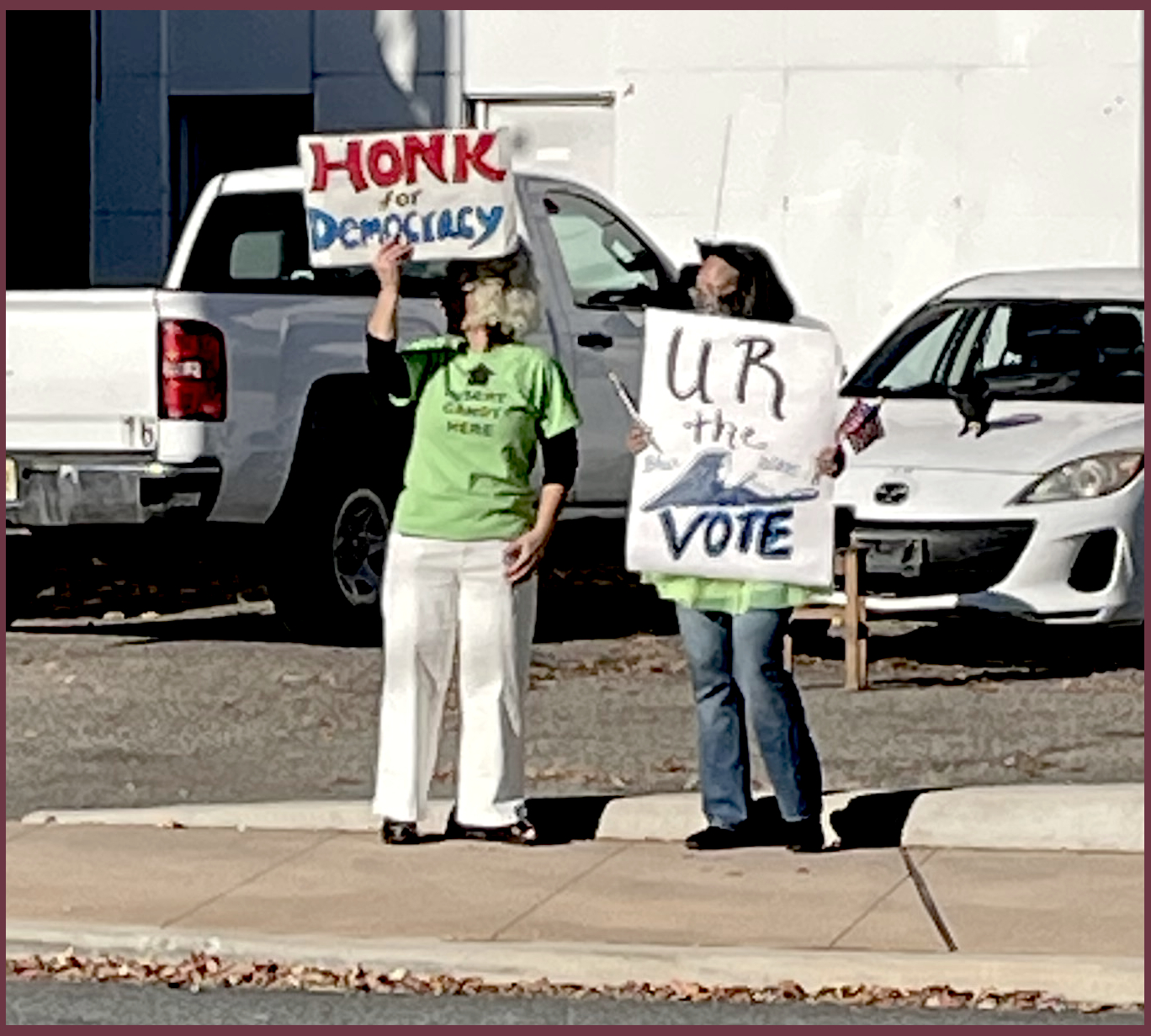
Now, back to the essential, timeless message of this November: The gravely wounded body of American Democracy got up from the operating table and voted. The peaceful action of 120 million citizens stopped a tyrant.
Trump brashly governed, if you can call it that, as if he held a mandate to be king. Since inauguration day there have been many moments when it seemed the electorate was too distracted to care. On November 3 we heard a roar: “We are not okay with this.”
Thank you, America.
© 2026 Newsjunkie.net