
Who's behind the news?
Who's behind the news?
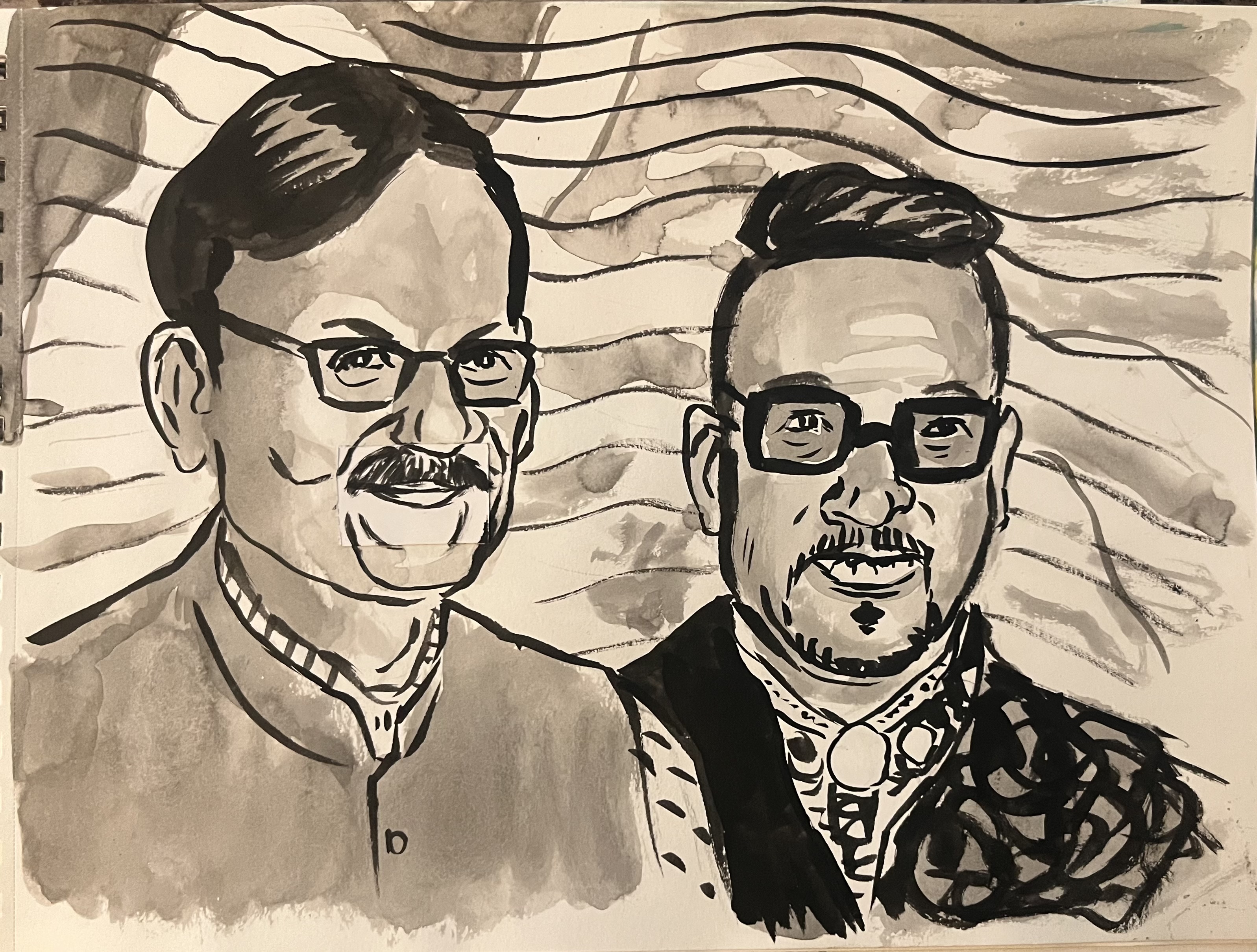
Prince Manvendra Singh Gohil and Duke DeAndre Richardson: Lives of courage and truth
Mavendra Singh Gohil, His Royal Highness, Crown Prince Manvendra Singh Gohil of Rajpipla, is the first royal, worldwide, to come out as gay. The groundbreaking reveal occurred in 2006 through an interview published in Divya Bhaskar, a Gujarati-language newspaper. Subsequently picked up and translated into other languages, the story eventually covered the globe, bringing recognition and notoriety to the then 40-year old Prince. Despite family pressure and death threats, Prince Manvendra embraced his unique position and bravely set out to advocate for gay rights, and the rights of other disadvantaged communities. Together with his American husband, DeAndre Richardson (styled as His Highness Prince DeAndre, Duke of Hanumanteshwar), Prince Manvendra has energetically worked to advocate for LGBTQ+ rights, for tribal and adivasi rights, and on behalf of victims of human trafficking. Prince Manvendra and Duke DeAndre agreed to sit for an interview at the conclusion of meeting on the planning of a cultural center for the Sidis of Gujarat (Indians of African descent). Newsjunkie publisher Gordon Whiting attended the conference with his partner Amy Catlin Jairazbhoy, professor of ethnomusicology at UCLA, a noted expert in Sidi studies. | ||
Our talk centered on press coverage of their unique story. For clarity and simplicity we use their given names, with no disrespect for their royal titles or positions intended. |
We are in Dang Forest Retreat in Gujarat, India. I'm with—I know I’m not going to get this right—the Prince of Rajpipla and his husband, DeAndre. They have been a public couple in this part of India for a number of years. Not only are they public, they are a married gay couple, and have elected to be open and celebratory about it. May I ask you to please say your titles and names for the record?
Manvendra Singh Gohil
By royal title, ‘His Royal Highness, Crown Prince.’ My name is Prince Manvendra Singh Gohil. I'm the Crown Prince of Rajpipla in the state of Gujarat.
DeAndre Richardson
I'm ‘His Highness Prince DeAndre, Duke of Hanumanteshwar.’
At what point did you become a public couple, and at what point were you married?
Manvendra
We got married in 2013, which now will be 12 years in 2025. Since same-sex marriage is not recognized in India, we got married in the US–in Seattle–in the presence of my in-laws. We have been open internationally, but specifically in India. It happened very recently, after we renewed our wedding vows in Ohio, in 2022, on our 9th anniversary. We were hosted by Harold D’Souza, a friend of ours, and a survivor of human trafficking.
With him, we started Eyes Open International, a nonprofit organization working on human trafficking slavery. He hosted this ceremony in Columbus, Ohio, where Abraham Lincoln gave a speech. That's when Indian media reported us as a married couple. Till then, the media in India knew about DeAndre in the royal establishment in Rajput, but they knew him as my friend, as an aide, as a consultant. One quoted him as my spiritual consultant. But after this news came out on Facebook, the Indian media reported this. They reported that we just got married, which was not true.
They got the details wrong, but the overall fact of marriage was reported.
Manvendra
Yes.
Did you have a plan to ease the media in on this?
Manvendra
I wasn't pushing the media to report us. I come from a traditional, old conservative background, having someone in my life, who was not an Indian citizen, with a different background, a different spiritual identity—there were multiple issues. We thought it best to not declare it because it would unnecessarily draw attention.
Also, there was a lot of jealousy that would lead to more complications in the royal establishment. We had to have a plan. We had not talked about it openly in Indian media, even though the international media knew and had spoken about us. The Indian media didn't talk until we did the Ohio ceremony.
DeAndre
Like the big open secret.
Manvendra, you were in an arranged marriage with a woman. Had that ended at the point when you became a couple with Deandre?
Manvendra
My marriage with the princess happened in 1991. It was a long time back, before I came out to myself. The termination of that marriage led me to explore myself, my sexuality. My ex-wife, when she left me, left a message saying: You did try to spoil my life. Please do not do it with another girl. And that message instigated my journey to discover myself, to find where I went wrong. Why did the marriage fail? During that journey I discovered myself as a gay man, almost four years after.
She had an interesting role to play in your journey.
Manvendra
Her last words prompted me to take this step. I came out to myself. I came out to my parents, much later. I came out to the world finally, in 2006. I met DeAndre on social media around 2008. We then met in India. It was a long process.
Let's talk about the timeline when you came out to the media. How did you do that, and what was the reaction?
Manvendra
I was motivated to take this step, because my parents had been torturing me after I came out to them. They were bent upon curing me. They thought this was a disease. They didn't accept the fact that I could be born gay, because it was a stigma for the reputation of the family. They were scared that this secret should not be revealed. They were not ready to accept it.
It's my understanding you were the first royal, worldwide, to come out.
Manvendra
Yes.
So that also was weighing on them, that it would be their family, right? That would be breaking this ground that would add to their discomfort.
Manvendra
Yes. India is a country of paradox, where homosexuality exists–especially within the royal families. I've heard my parents talk amongst each other, naming gay or lesbian people from the royal families, but when it comes to my own family, they don't want to accept it. That is one reason I took this step.
I am a human being. I have my human rights. I have my dignity and respect. Why should I be tortured, humiliated, put to shame, and suffer the violation of my human rights at the hand of my parents, for no fault of mine?
But that's a large step of growth.
Manvendra
Yes. I wanted to break this prevailing hypocrisy. I mean, we all know India is the land of Kama Sutra, the world's oldest sex encyclopedia. It openly talks about homosexuality and lesbianism. And yet, basic sex education is missing in this country. I wanted to break the silence and talk on a subject existing in our culture, and yet people were not accepting it. That was the reason to take this bold step, coming out to the whole world, becoming the first member of a royal family in the world to do so.
How did you make that announcement? How was the press?
Manvendra
I was waiting for the opportunity. A journalist came to know about my sexuality through my trust. I started a nonprofit organization in 2000 called Lakshya Trust. She came to know that one of the board members is a prince. She approached me and asked, “Would you like to talk about your life?” I was waiting for someone like her to approach me. I immediately agreed.
I would like to say that I compared myself to a dog always wanting freedom, but I was strapped; clutched. I was not given freedom to express myself or do what I wanted. I was living a double life. I wanted to become free. I saw this opportunity where I could get freedom to be who I am without harming anyone.
So she wrote a story, she did an interview-
Manvendra
Yes
And that ran in Gujarat?
Manvendra
Yes. It was the first time that a regional language newspaper brought out a positive story on homosexuality. It had never happened before. That was big, breaking, headline news. Almost half the page covered my story. It was picked up by other newspapers in other languages–even in English.
Had you ever had any coverage of that extent prior to—
Manvendra
Not to this extent. I had never been featured as breaking or the front page news before. It was big news. Gradually, TV media reported it. Radio media reported it.
Did you ever feel, "What have I done?"
Manvendra
I received death threats because I was the first royal family member to come out, but not the only gay Royal. Many Royals felt intimidated. They thought they needed to put an end to my being vocal. The only way they could put an end to that was to kill me. I received threats coming from people who directly told me “you better stop talking. Otherwise we will not leave you. We will kill you.”
I didn't expect you to say that. It was from fellow Royals around the world?
Manvendra
No, not from the world—Royals from India. Yes, Royals from India. I knew about them. They felt threatened. They said this guy has become shameless. He's outed himself. Time will come when he will out all of us, and then that would be the doom of the royal families of India.
The pressure went up fast.
Manvendra
Yes. With the death threats, I wondered, where did I go wrong? What have I said? I said only the truth, and nothing else. So, why are people against me? Why are they wanting to kill me? I told myself I haven't done anything wrong. I believe in being honest and truthful. The person who inspired me during this journey was Gandhi. I read his biography.
Through truth, honesty, and non-violence he got freedom from the Britishers. I said I will work on the same principles, truth and honesty. I will work relentlessly to see how I can get freedom for my LGBT brothers and sisters. Well, that's courage.
DeAndre, did you know how much the threat of violence was part of this when you first met?
DeAndre
Not when we first met, but when I started visiting India. And later, when I was married and knighted to the property, Then, I was aware of the danger.
How did you know? I mean, I don't mean to pry or make it more dangerous for you, but could you share how that information would get to you?
DeAndre
Manvendra told me. After I came to India, rather early on in our marriage, we had problems within the establishment. These threats were not outside. They were from within.
Manvendra
We have to be diplomatic. The situation is different here in India than in the US.
DeAndre
It would be a completely different story in the West. He's an Indian prince. The media attention in Europe or America is low compared to the way local media in India spins it.
I live in America for six months and I'm here for six months. When I'm in America, the focus is on European royalty. Streaming services came up with something like Red, White and Royal Blue, about a gay British, gay prince marrying an American–we already had that content for more than 10 years, but it's with brown people, right? You're running after and recreating something to fit a narrative–to sell to certain demographics.
I find that really interesting, because I can go to America and do whatever I want. If I tell someone I'm the Duke of Hanumanteshwar, they're just blown away. Like, really, what is that? When I'm here I can't leave my home. I can't leave the estate because it's unsafe. It's just completely different because I can't visit my father-in-law at his palace. because there are situations my husband is dealing with in the city. If I'm in public, then I could be in danger. It could endanger the work that they're doing. Because of the media.
Manvendra
I was visiting his mom. I didn't have to worry about if I'm going to visit my mother-in-law, as if there's media or something following me. But here it is the other way around. He hasn't been able to meet my father. He has to be very careful in his movements and my movements and everything is all very restricted.
DeAndre
Everything's orchestrated.
Media is a double-edged sword?
Manvendra
I would differentiate between media and social media. I received death threats almost every week, somebody telling me, “You dare come here. We'll not spare you.” Death threats haven't stopped yet. It’s social media where I received death threats. Whereas in the media, it’s interesting that the stories covered in print, when they get put up on social media, it is that story which is attacked. And then, I get these death threats coming.
The thing with local media in India, the local media in Rajpipla is, they want to be paid. If you don't pay them money then you don't have a favorable article. I find this disheartening. If you find something interesting cover that, versus seeking a payment.
Extraordinary. Back to matters of the press, I assume there has been an evolution of how the press has treated you. In recent years, I've seen you lead celebratory events, and I think the last time we spoke, DeAndre, you said you're essentially the most famous couple that have a royal connection, something along those lines. You're well-known in the gay community, but you're well-known period. The press is part of that. How has the coverage changed since you did that first interview?
Manvendra
I think the press has changed a lot. We have done advocacy with the media. Initially, they had issues with quoting positive stories on us. But then gradually they have understood that we mean it. They say that we are a gay couple–we are a royal couple–gay royal couple. They have mentioned us appropriately.
But there have also been times when, during some discussion, the audience asks this question— “Between the both of you, who's the husband and who's the wife?” Questions like that come very often from the audience. And, we have to explain to them the concept of husband and wife, husband and husband, wife and wife.
You take it as an opportunity to talk?
Manvendra
Exactly. Sex education is missing in our educational system. People are not used to talking about these issues. Their ignorance on the subject is to be blamed. I don't blame the people because they're ignorant about it and have misconceptions. They confuse gay and transgender as the same thing. They don't distinguish between them. To them, gay and transgender are the same. We need to educate them and tell them gay is one identity, transgender is another. The two are not the same.
I'll make a point here for our readers. India has a different culture around representation of cross-dressing and transgender practices than we have in the West. There really is no parallel. We also have at the table Professor Amy Catlin of UCLA, who also has made a study of the traditions of transgenders in India—Jogtas, Devadasis, and Devadasas. Professor Catlin, could you speak about that? It's not something that we grasp in the West, but it is a part of the culture here.
Professor Amy Catlin-Jairazbhoy, UCLA
There's long been a role in Indian society for different types of sexuality. This is documented in the Kama Sutra and is still living today in different Indian cultures. Certainly, in India, we have examples of lesbians and transgenders and homosexuality of females and males.
As part of a religious tradition?
Amy
Sometimes, yes, as a part of religious traditions that are sanctioned and valued positions. When a person becomes a Jogta–these are transvestites, who would be considered to be transgendered people in worship of the goddess Renuka-Yellama, portraying or living as her sons who were emasculated by their father during his altercation with their mother. This goes back to the Vedas. It's a longstanding niche. People of different sexualities have options of playing different roles with other members of the same sex or opposite sex.
I wanted to bring that up because it's not simply found in Judeo-Christian culture. One might say the West is ahead in acceptance of homosexuality, particularly in America, Britain and Europe. Not completely accepting, but ahead of India, perhaps.
On the other hand, there are traditions here which would be unexplainable in the West. Differences that are important to note. I have no explanation for them personally, other than to say they exist. They're long-standing, so it's not just a matter of Indians being backward in acceptance of non-mainstream lifestyles.
I want to bring the mic back to Manvendra and DeAndre. How do you see the challenges for greater acceptance, going forward?
Manvendra
We had an amendment to our Indian constitution, where homosexuality was decriminalized. When the British colonized us, they criminalized homosexual acts. We went to the court, and we fought for almost two decades, and finally, in 2018 we got a judgment in our favor that homosexual relationships are no longer to be considered criminal so long as the partners are adults and have consent. That was quite a historic verdict.
However, in India, laws don't get implemented easily. The dissemination of law is slow. Even though we won this case in 2018, it's been seven years. There is still stigma and discrimination. There is still a violation of human rights at the workplace, at the family level, and at society at large. We still struggle with rights in spite of the law being in our favor. It is very important for us as activists to keep doing advocacy. We need to educate the people about this law.
DeAndre
Also, in 2018 a majority of India’s educated people think, right now, that marriage equality is linked to that ruling, that same-sex marriage is legal. People don't go beyond a headline.
Because it's no longer criminal—
Manvendra
Yeah, they say why do you need marriage equality? You're already got the marriage rights in 2018 and then we have to tell them we have not got marriage rights. We can have sex with each other's consent and not go to jail. That is the only breakthrough, but we cannot get married. Ignorance still prevails. Advocacy needs to be done at all levels.
What is the advocacy you do?
Manvendra
Advocacy has to be done with all levels, all stakeholders, starting from the political leaders, the government officers, education institutions, doctors, the the judicial authorities, the media, the students---
Talking to them?
Manvendra
Yes, we're lobbying with them. The idea is to create allies, because it's very important for us to create allies. An individual, institution, or organization not from the LGBTQ plus community, and yet openly supports us and helps us get support. That's what I call an ally. An ally is very important because an ally will help mainstream our issues. We don't want to be treated as exclusive human beings. We want to be treated as inclusive. We are not asking for any special rights or special favors. We want to be treated just like any other citizen.
This is a mature strategy. How did you develop this?
Manvendra
This has been followed by practically all LGBT rights activists in India. We talk to political parties and others in government. It's important to have representation. Just now what is happening is that we don't have a representative in the House of Parliament. We don't have representatives in the ministry. We don't have representatives in the government. It is important that if we have representation it will help if the people understand our issues.
Because who is the government? The government consists of the same people who have received education from the same education institutions where they're not taught about sex. How are they going to understand our issues when they are totally ignorant on the subject?
I'll give you an example. There is this paradox in India, where the gay and lesbian populations have not been given many rights. The transgender community in India has been given rights. India was perhaps one of the first countries in the world to have got transgender protections from the Supreme Court in favor of them in 2014. In 2019 both Houses of Parliament passed a bill, the Transgender Protection Act, where rights have been given to the trans community. In fact, gay and lesbian cannot marry in India. Transgenders can marry in India legally.
DeAndre
Also, some people think lesbians and gays are transgender, as if therefore there's nothing more to move on.
Manvendra
The government, around four years back, announced that, as per the Transgender Protection Act in 2019 the states should have a transgender shelter home funded by the government to house them, feed them and train them, build their capacity. They can have job opportunities and be self employed. They can live with dignity and respect. India is one of the first countries in the world to have started this concept.
Now, a transgender person has been appointed and sits in the government office as a member of the executive committee under the Ministry of Social Justice and empowerment, and she advises the government about the role of this transgender schedule. Representation is important.
And, because Newsjunkie covers what the press does, how is the press responding to your effort?
Manvendra
The press has its own axe to grind. They need, as we call it in Indian language, masala. They have been positive, no doubt. But then they always look for gossips, or masalas to make their story more rosy and fun, because they have to sell newspapers. They need to make that a story that people will read. They will add unnecessary things. It has been a long process. They've been putting derogatory terms in. We have educated them and said these are not the words to use. For example, about the terms husband and wife. We try to get them to use the word spouse, which is a neutral word. There is no husband, there is no wife, but there is spouse. We educate the media to change their terminology.
Would you say there is progress?
Manvendra
Yes, there is progress. And as I will repeat, we are trying to make our representation strong. Now we have the queer media collective, which comprises of newspapers, magazines, television, podcasts, and radio, all from the community, and they have all come together. That way we see progress happening.
How widely have you been covered? Has The Advocate in L.A. covered you?
Manvendra
The Advocate has covered. LA Times also has covered me.
LA Times, I saw, but I don't think I've seen The Advocate piece.
Manvendra
A long time back, The Advocate covered me. Out magazine did a good feature on both of us, and we are in Seattle. They had interviewed us both. That was digital. It was a really nice interview.
DeAndre
That was a nice article about our memoir that just came out.
The name of your memoir is--
Manvendra
A Royal Commitment: Ten Years of Marriage and Activism.
And publication and distribution?
DeAndre
October 1 of last year. You can get it on Amazon. You can it get at H1927. You can get exclusive color copies there, but you can get anywhere books are sold.
It's an interesting read. A lot that had happened in 10 years.
Manvendra
Today, I read a part of it at a conference for the Sidi community. There's a small part about the Sidis in the memoir.
DeAndre As a gay royal couple, our very first tour was to the kingdom of Cambay. The Nawab and Begum had given us the same treatment that they would have given Manvendra when he was married to a princess. We received garlands and were recognized; yeah.
Manvendra
They were very open about accepting us. They invited us for lunch. The Crown Prince and his wife; very nice.
For the people, our identity as royals doesn't exist. But we are still the custodians of this rich cultural heritage. It has to continue whether title is there or not. We cannot erase history. It has to remain alive, and it has to be passed on from generation to generation.
I mean, today. We have our temple–our goddess. Last year we celebrated 423 years of our temple. We had the opportunity of being invited to sit on the chariot, to be in the procession celebrating 423 years. And we are there in the chariot as a couple.
DeAndre
There's a newness of how to move these dynasties forward, how to preserve what needs to be preserved from different backgrounds. It was nice. It will be fascinating to see the next generation. How are you preserving the things that are really important to the people? If it's important to the people, then it has to be important to my husband and has to be important to me. Ω
-Edited for clarity
Sources
Interview conducted Tuesday, January 14, 2025, at Dang Forest Retreat, Gujarat, India. Historian and social activist Sonal Mehta convened a meeting of the Sidi Cultural Arts committee, attended by Professor Beheroze Shroff of UC Irvine, Professor Amy Catlin-Jairazbhoy of UCLA, Princess Farah Khan of Suchin, Pavan Patel, Niyati Kukadia, and Prince Manvendra and Duke DeAndre, among others.
Out. First gay prince comes out
The Advocate. World’s first openly gay royal is on fairy tale search for love
Lakshya Trust. About
Contact information. Manvendra’s LinkedIn, DeAndre’s LinkedIn,
Lakshya Trust email address: lakshyatrustrajkot@yahoo.com
© 2025 Newsjunkie.net