
Who's behind the news?
Who's behind the news?
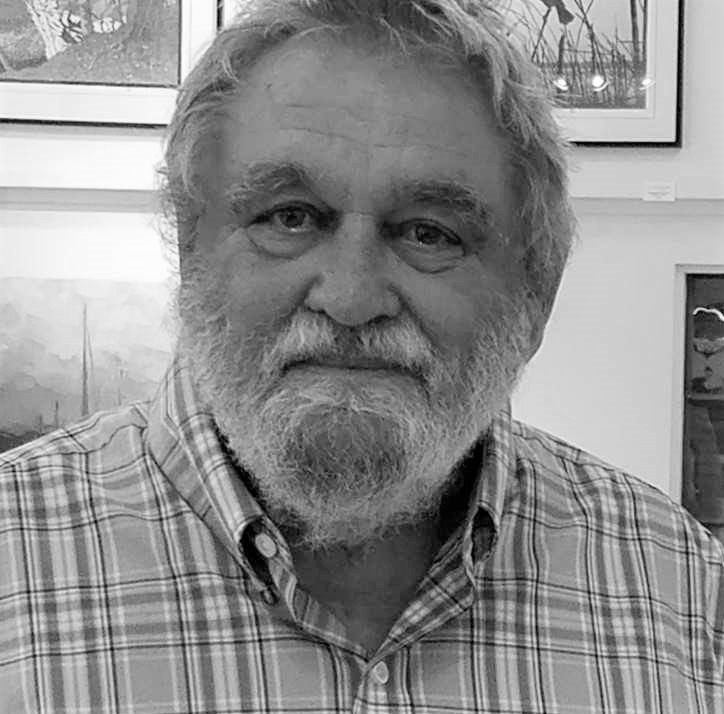
Louis Jenkins, Charles Simic, and the strange literary form that refuses to stay in its lane
The Prose Poem
by Louis Jenkins
The prose poem is not a real poem, of course. One of the major differences is that the prose poet is incapable, either too lazy or too stupid, of breaking the poem into lines. But all writing, even the prose poem, involves a certain amount of skill, just the way throwing a wad of paper, say, into a wastebasket at a distance of twenty feet, requires a certain skill, a skill that, though it may improve hand-eye coordination, does not lead necessarily to an ability to play basketball. Still it takes practice and thus gives one a way to pass the time, chucking one paper after another at the basket, while the teacher drones on about the poetry of Tennyson.
Louis Jenkins’ "The Prose Poem" begins with a deadpan provocation: "The prose poem is not a real poem, of course." The joke works because it echoes a criticism the form has endured since its birth. If poetry is supposed to have lines, stanzas, meter, or rhyme, what are readers supposed to make of a paragraph that insists on calling itself a poem? Jenkins' answer is playful, but the question is serious. The prose poem has spent much of its history defending its right to exist.
The prose poem is a slippery form: quirky, suspect, peculiar, and almost impossible to classify. It did not begin with Charles Baudelaire alone, though Baudelaire helped make it famous. One of its major nineteenth-century precursors was Aloysius Bertrand’s Gaspard de la Nuit, published in 1842 and often cited as one of the first modern prose-poetry collections. Baudelaire later took inspiration from Bertrand for Le Spleen de Paris, also known as Petits Poèmes en prose, which was published posthumously in 1869 and became foundational for the modern prose poem.
The form has always made some readers uneasy. A prose poem does not look like a conventional poem. It has no line breaks, no stanzas, and usually no visible meter or rhyme. On the page, it can appear to be nothing more than a paragraph made of sentences. Yet its compression, image-making, music, strangeness, and self-contained force give it the pressure of poetry. As David Lehman writes in his anthology Great American Prose Poems: From Poe to the Present, the prose poem can use the “strategies and tactics of poetry” while working in sentences rather than lines.
That tension—between poetry and prose, lyric and paragraph, freedom and form—made the prose poem an outsider genre. Its defenders saw possibility in that outsider status. Its skeptics saw a trick: prose pretending to be poetry. But the form endured because it could do things that traditional verse often could not. It could tell a story in miniature, stage a joke, deliver a dream, or twist a familiar scene into something uncanny.
Charles Simic became one of the great American masters of that uncanny miniature. Born in Belgrade in 1938, he spent part of his childhood under the shadow of World War II before immigrating with his family to the United States. He attended high school in Oak Park, Illinois—the same community and school associated with Ernest Hemingway, though decades later—and later became one of the most distinctive American poets of his generation.
Simic’s prose poems are terse, darkly comic, dreamlike, and sometimes disturbing. In The World Doesn’t End, he compresses whole fables of poverty, war, memory, and absurdity into a few sentences. The book, published in 1989, won the Pulitzer Prize for Poetry in 1990, a significant recognition for a collection of prose poems.
Some of Simic’s best-known lines show why the form suited him so well. “I was stolen by gypsies. My parents stole me right back. Then the gypsies stole me right back. This went on for some time.” Elsewhere he writes, “We were so poor I had to take the place of the bait in the mousetrap.” The sentences are plain, but the effect is not. They behave like jokes, nightmares, family legends, and folk tales all at once.
The prose poem’s power comes from this collision. It borrows the outward shape of prose but refuses the ordinary expectations of prose. It is not an essay, not quite a story, not quite a lyric poem, and not a fragment in the usual sense. It is a hybrid form—part narrative, part image, part riddle. Simic himself described prose poetry as depending on “a collision of two impulses,” prose and poetry.
W.S. Merwin, another poet associated with work at the boundary of poetry and prose, admitted that he was “not at all sure what the genre is supposed to entail.” That uncertainty is part of the point. The prose poem asks readers to reconsider where poetry actually resides: in the line, or in intensity? In visible form, or in the way language turns back on itself and asks to be reread?
The line break is the one great convention the prose poem gives up. In exchange, the sentence and paragraph must do the work usually assigned to verse and stanza. A prose poem may look casual, but the best examples are highly charged. They depend on pacing, compression, surprise, and closure. Once read, they often demand to be read again.
Perhaps the prose poem’s most ironic newspaper motto comes from Citizen Kane. A reporter cables that there is no war in Cuba and offers instead to send “prose poems about scenery.” Kane replies: “You provide the prose poems, I’ll provide the war.”
It is a joke about journalism, empire, and manufactured drama. But it also captures something true about the prose poem itself. The form looks modest. It arrives without the uniform of verse. Then, quietly, it detonates.
Louis Jenkins' poems have been published in a number of literary magazines and anthologies. He published 14 collections of his poetry. He was awarded two Bush Foundation Fellowships for poetry, a Loft-McKnight fellowship, and was the 2000 George Morrison Award winner. Louis Jenkins frequently read his poetry on A Prairie Home Companion and was a featured poet at the Geraldine R. Dodge Poetry Festival in 1996 and at the Aldeburgh Poetry Festival, Aldeburgh, England in 2007. – from the author’s website
Poem copyright the author, column © 2026 Newsjunkie.net