
Who's behind the news?
Who's behind the news?
A liberal streamer pitches big-tent politics to a small crowd—and thousands online
April 6, 2026
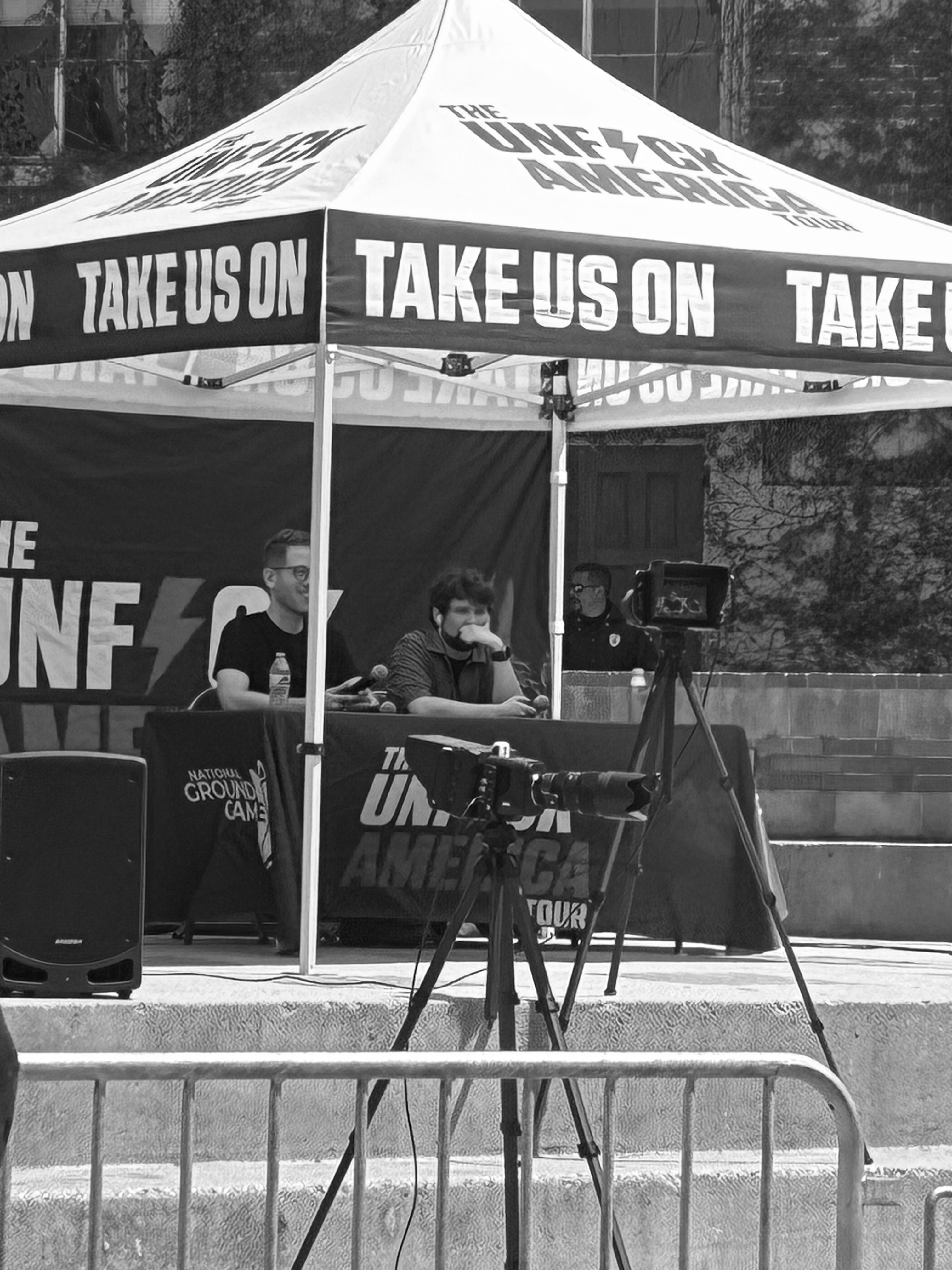
On a recent afternoon at UCLA, a tent went up, a crowd gathered, and a political streamer set up shop to talk to students about the state of America. The security presence, officers idling against buildings and others keeping watch from rooftops, was a signifier of how the landscape of campus events has changed since Charlie Kirk was fatally shot at Utah Valley University on September 10, 2025. Political gatherings on college campuses now come with overhead.
The man under the tent was Steven Kenneth Bonnell II, known online as Destiny, a liberal political streamer who has been holding these events as part of the Unfuck America Tour, a progressive political campus event series aimed at countering Turning Point USA. The tour is organized by National Ground Game, a political action committee that operates both on the ground and online, working to build a Democratic presence on campuses and reclaim the youth vote. The UCLA stop was, by the numbers of people physically present, a modest affair. The virtual audience watching the livestream, however, accumulated into the thousands. That gap between the bodies on the ground and the eyes on the screen may be the most revealing thing about what these events are, and who they're for.
Destiny's path to this particular tent is an unlikely one. Born into a conservative Catholic home, he came to fame as a Twitch gamer with libertarian, anti-social justice warrior beliefs. In 2012 his political outlook began shifting toward liberalism after an incident in which he heard another streamer use a homophobic slur. That moment of recoil from the ugliness of his own political neighborhood sent him on a gradual journey toward the classical liberalism he espouses today, more centrist than the streamers who skew democratic socialist, but unmistakably on the left side of a spectrum.
What makes Destiny unusual, and unusually effective, is his willingness to actually show up and argue. He is among the few prominent left-leaning streamers who has publicly debated major conservative figures; sitting across from the likes of Ben Shapiro, Jordan Peterson, and Alex Jones, and engaging them directly rather than mocking from a distance. Subsequent coverage of right-wing YouTube commentary has credited Bonnell as an early and effective counterweight, particularly owing to his combative debate style which appeals to right-wing gaming audiences. That willingness to engage is precisely what conservative commentators have historically used to build audiences, a tactic the left was never good at.
His intention is not to persuade his opponents but to persuade the audience
Destiny has stated that his intention is not to persuade his opponents but to persuade the audience, and though he has expressed that airing his opinions often feels like screaming into the void, he estimates he has received hundreds of emails from former members of the alt-right crediting him for their conversion to left-wing ideas. He is not primarily in the business of winning debates. He is in the business of being watched by people who are still making up their minds, and he understands, perhaps better than most political voices, that those people are often not in the room.
The broader streaming left that Destiny helped incubate has since diverged sharply from his centrist lane. The most prominent figure to emerge from that ecosystem is Hasan Piker. Piker, AKA HasanAbi, first appeared on Destiny's stream in 2018 and became a regular presence before a series of ideological and personal fallouts pushed them apart. Piker has since built one of the largest political audiences on the internet from a position well to Destiny's left. The two represent opposite poles of what the streaming left has become: Destiny the debater who engages conservatives on their turf, Piker the movement voice who speaks primarily to the already converted. The irony that it's Destiny, not Piker, who ended up on a college campus trying to persuade the undecided is not lost on anyone watching closely.
At UCLA, that dynamic played out in miniature. The students who showed up were, based on their questions, largely already sympathetic. Voter registration tables had been set up, though most of those registering would almost certainly be pulling Democratic levers. Only one question during the event was genuinely confrontational, and even that wasn't a defense of MAGA—It was an argument that there was little difference between what Trump is doing and what Biden had done before him. The questioner was notably older than the rest of the crowd, and the challenge landed more as cynicism than as conservatism.
The sparse turnout of ideological opponents was not, in itself, surprising. Destiny has promoted the idea that college campuses should have students with diverse opinions in order to reduce polarization. But finding conservative voices willing to engage on a campus like UCLA is a problem. Someone in the crowd had even brought a sign calling for conservatives to attend, a gesture that was either optimistic or quietly resigned, depending on how you read it.
The contrast with what Turning Point USA was doing before Kirk's assassination is worth sitting with. Kirk built a machine designed to put conservative voices directly onto campuses, to go where the opposition lived and force confrontation. The Unfuck America Tour is, in some ways, an attempt to build a mirror-image operation, but the asymmetry is real. Liberal students on liberal campuses do not need to be recruited to attend events by their own side. They show up. The challenge is getting anyone else to.
What Destiny seems to understand, though, is that the physical event is increasingly not the point. The tent at UCLA was a production set. The debate that happened there, such as it was, was content. The thousands watching online were not passive observers of a campus conversation; they were the real target. Whether that model can actually move political opinion among the young men most susceptible to right-wing online radicalization, the demographic Destiny claims to have the most success with, is a question the event itself couldn't answer. Campus tours and livestreams are a delivery mechanism. Whether the message lands remains to be seen.