
Who's behind the news?
Who's behind the news?
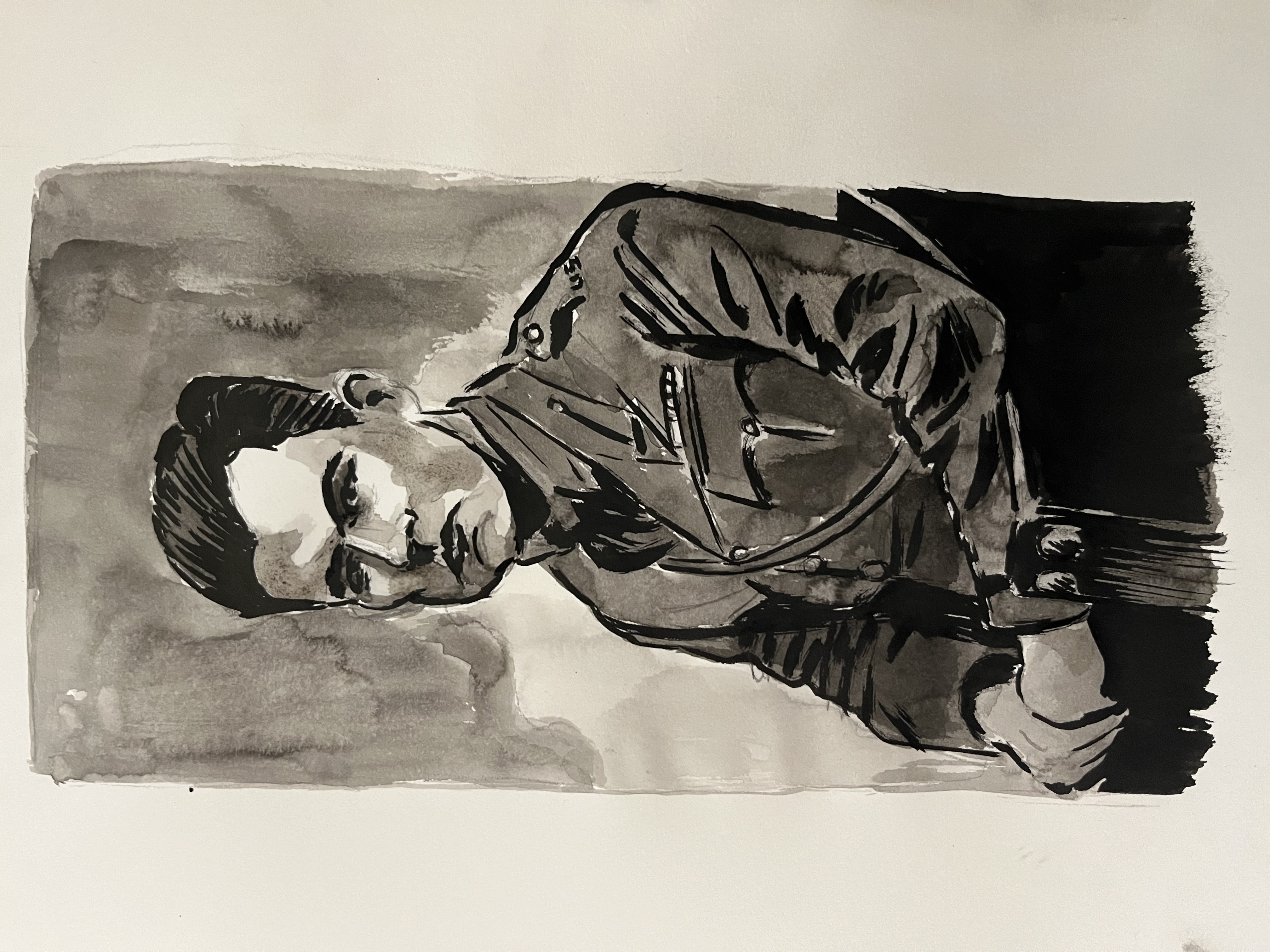
Ernest Hemingway in Paris
by Ernest Hemingway
Toronto Daily Star, April 13, 1923
To write about Germany you must begin by writing about France. There is a magic in the name France. It is a magic like the smell of the sea or the sight of Blue Hills or of soldiers marching by. It is a very old magic.
France is a broad and lovely country. The loveliest country that I know. It is impossible to write impartially about a country when you love it. But it is possible to write impartially about the government of that country. France refused in 1917 to make a peace without victory. Now she finds that she has a victory without peace. To understand why this is so we must take a look at the French government.
France at present is governed by a chamber of deputies elected in 1919. It was called the “horizon blue” parliament, and is dominated by the famous “bloc national” or war time coalition. This government has two years more to run.
The 1919 Chamber of Deputies was nicknamed the “bleu-horizon” (horizon-blue) chamber because so many of its deputies were WWI veterans, and “horizon blue” was the color of French wartime uniforms. | ||
A broad, post-WWI coalition of the right and center-right formed for the 1919 elections amid a nationalist mood and anti-Bolshevik campaigning. It won an overwhelming majority in November 1919 and dominated government through 1924—hence Hemingway’s description of a parliament “dominated by the famous ‘bloc national.’” Its leaders/governments pushed strict enforcement of Versailles and, under Poincaré, the 1923 occupation of the Ruhr. |
The liberals, who were the strongest group in France, were disgraced when Clemenceau destroyed their government in 1917 on the charge that they were negotiating for peace without victory from the Germans. Caillaux, admittedly the best financier in France, the Liberal premier, was thrown into prison. There were almost daily executions by firing squads of which no report appeared in the papers. Very many enemies of Clemenceau found themselves standing blindfolded against a stone wall at Versailles in the cold of the early morning while a young lieutenant nervously moistened his lips before he could give the command.
This Liberal group is practically unrepresented in the chamber of deputies. It is the great, unformed, unled opposition to the “bloc national” and it will be crystallized into form at the next election in 1924. You cannot live in France any length of time without having various people tell you in the strictest confidence that Caillaux will be Prime Minister again in 1924. If the occupation of the Ruhr fails he has A very good chance to be. There will be the inevitable reaction against the present government. The chance is that it will swing even further to the left and pass over Caillaux entirely to exalt Marcel Cachin, the Communist leader.
Joseph Caillaux was the former premier of France (1911-1912). A finance wizard, he became disgraced and then jailed for alleged wartime treason for favoring a negotiated settlement to end the war. By 1923 he was the ever-whispered comeback hope of the center-left. |
The present opposition to the “bloc national” in the Chamber of Deputies is furnished by the left. When you read of the Right and Left in continental politics it refers to the way the numbers are seated in parliament. The Conservatives are on the right, the monarchists are on the extreme right of the floor. The radicals are on the left. The communists on the extreme left. The extreme communists are on the outside seats of the extreme left.
The French communist party has twelve seats in the chamber out of 600. Marcel Cachin, editor of L’Humanité with a circulation of 200,000 is the leader of the party. Vaillant Coutourier, a young subaltern of Chasseurs who is one of the most decorated men in France, is his lieutenant. The communists lead the opposition to M. Poincaré. They charge him with having brought on the war, with having desired the war, they always refer to him as “Poincaré la guerre.” They charge him with being under the domination of Léon Daudet and the royalists. They charge him with being under the domination of the iron kings, the coal kings; they charge him with many things, some of them very ridiculous.
Marcel Cachin, editor of L’Humanité, was a leader of the French Communists in the Chamber of Deputies. He firmly opposed Poincaré and the Ruhr occupation. | ||
Poincaré was the architect of the French-Belgian occupation of the Ruhr, launched January 11, 1923, to force German reparations compliance—Hemingway’s “victory without peace” backdrop. In practice this meant economic/military pressure, seizures of output, and a bet that toughness would secure France’s postwar safety. |
M. Poincaré sits in the chamber with his little hands and little feet and his little white beard and when the communists insult him too far, spits back at them like an angry cat. When it looks as though the communists had uncovered any real dirt and members of the government begins to look doubtfully at M. Poincaré, René Viviani makes a speech. Monsieur Viviani is the greatest orator of our times. You have only to hear M. Viviani pronounce the words, “la gloire de France” to want to rush out and get into uniform. The next day after he has made his speech, you find it pasted up on posters all over the city.
Moscow has recently “purified” the French communist party. According to the Russian communists, the French party was mawkishly patriotic and weak willed. All members who refused to place themselves directly under orders from the central party in Moscow were asked to turn in their membership cards. A number did. The rest are now considered purified. But I doubt if they remain for long. The Frenchman is not a good internationalist.
The “bloc national” is made up of honest patriots, and representatives of the great steel trust, the coal trust, the wine industry, other smaller profiteers, ex-army officers, professional politicians, careerists, and the royalists.
While it may seem fantastic to think of France having a king again, the royalist party is extremely well organized, is very strong in certain parts of the south of France, controls several newspapers, including l’Action Française, and has organized a sort of Fascisti called the Camelots de Roi. It has a hand in everything in the government and was the greatest advocate of the advance into the Ruhr and the further occupation of Germany.
There, briefly, are the political parties in France, and the way they line up. Now we must see the causes that forced France into the Ruhr.
France has spent eighty billion francs on reparations. Forty-five billion francs have been spent on reconstructing the devastated regions. There is a very great scandal talked in France about how that forty-five billions were spent. Deputy Inghles of the department of the Nord, said the other day in the chamber of deputies that twenty-five billions of it went for graft. He offered to present the facts at any time the chamber would consent to hear him. He was hushed up. At any rate, forty-five billions were spent wildly and rapidly and there are very many new “devastated region millionaires” in the chamber of deputies. The deputies asked for as much money as they wanted for their own districts and got it and a good part of the regions are still devastated.
The point is that the eighty billions have been spent and are charged up as collectible from Germany. They stand on the credit side of the ledger.
If at any time the French government admits that any part of those eighty billion francs are not collectible they must be moved over to the bad side of the ledger and listed as a loss rather than an asset. There are only thirty billions of paper franc in circulation today. If France admits that any part of the money spent and charged to Germany is uncollectible she must issue paper francs to pay the bonds she floated to raise the money she has spent. That means inflation of her currency, resulting in starting the franc on the grease skid the Austrian kronen and German mark traveled down.
When Aristide Briand, former prime minister, who looks like a bandit, and is the natural son of a French dancer and a cafe keeper of St. Nazaire, agreed at the Cannes conference to a reduction in reparations in return for Lloyd George's defense pact, his ministry was overthrown almost before he could catch the train back to Paris. The weasel-eyed M. Arago, leader of the bloc national, and Monsieur Barthou, who looks like the left hand Smith brother, were at Cannes watching every move of Briand and when they saw he was leaning toward a reduction of reparations, they prepared to skid him out and get Poincaré in—and accomplished the coup before Briand knew what was happening to him. The bloc national cannot afford to have anyone cutting down on reparations because it does not want any inquiry as to how the money was spent. The memory of the Panama Canal scandal is still fresh.
Poincaré came into office, pledged to collect every sou possible from Germany. The story of how he was led to refuse the offer of the German industrialists to take over the payment of reparations if it was reduced to a reasonable figure, and the sinister tale that is unfolding day by day in the French Chamber of Deputies about how Poincaré was forced into the roar against his own will and judgment, is a strange story of the rise of the royalists in France and their influence on the present government.
#
Ernest Hemingway was 23 years old when he filed this story for the Star.
Toronto Daily Star article “A Victory Without Peace” is in the public domain.
Source: Gene Z. Hanrahan "Hemingway: Toronto Star" Dell Publishing 1967
Republished by Newsjunkie October 30, 2025
Commentary by Gordon J. Whiting © 2025 Newsjunkie.net